Abstract
Oral cancer represents an important global health concern especially in South Asian countries like India where it is among the world's highest oral malignancy incidences [1]. Major risks that associate with oral cancer include using tobacco (smoked or smokeless), excessively consuming alcohol, practicing poor oral hygiene, along with infecting with human papillomavirus (HPV) [2,3]. A low survival rate still persists, even with advancements in diagnosis and treatment, because presentation and diagnosis are often delayed due to inadequate screening practices and also low public awareness [4]. Early detection has a major role in improving prognosis and survival rates. Hence, preventive strategies must include public education, professionals must check teeth routinely, together with professionals must intervene for behavioral change
Introduction
Oral cancer represents an important global health concern especially in South Asian countries like India where it is among the world's highest oral malignancy incidences [1]. Major risks that associate with oral cancer include using tobacco (smoked or smokeless), excessively consuming alcohol, practicing poor oral hygiene, along with infecting with human papillomavirus (HPV) [2,3]. A low survival rate still persists, even with advancements in diagnosis and treatment, because presentation and diagnosis are often delayed due to inadequate screening practices and also low public awareness [4]. Early detection has a major role in improving prognosis and survival rates. Hence, preventive strategies must include public education, professionals must check teeth routinely, together with professionals must intervene for behavioral change [5].
A structured questionnaire survey will be used in this study to assess adults' oral cancer awareness, risk perception, and preventive behaviors so that existing gaps are identified as well as timely preventive action is promoted [6].
Methodology
Objective
The primary objective in this study was that we assess how aware adults are about oral cancer symptoms and risk factors. Also, objectives included evaluating the association amid lifestyle habits like tobacco and alcohol use and oral cancer awareness. The study did further determine the willingness shown by participants to undergo oral cancer screening and did identify demographic factors that had influenced preventive behaviors.
Participants
This study included individuals aged 18 years and above from both urban and rural areas. Participants were selected based on their willingness to participate and ability to understand the content of the questionnaire. Individuals with cognitive impairments or language barriers were excluded from the study to ensure accurate responses.
Data collection
Data were collected through a structured and pre-validated questionnaire distributed in both physical and digital formats. The questionnaire was originally designed in English and translated into the local language where needed. It included multiple-choice and yes/no questions covering demographic details, personal habits (tobacco and alcohol use), dental visit frequency, awareness of oral cancer signs and risk factors, and attitudes toward screening and prevention. Informed consent was obtained from all participants prior to data collection.
Sampling Techniques
A non-probability convenience sampling method was adopted due to time and resource constraints. This approach enabled access to a diverse range of participants quickly and efficiently; however, it may affect the generalizability of the findings to the broader population.
Data analysis
Responses were compiled within Microsoft Excel then were analyzed inside SPSS (Statistical Package for the Social Sciences) software, version XX. Participant characteristics and awareness levels were summarized through descriptive statistics like frequencies and also percentages. We used chi-square tests to examine associations between awareness with behavioral factors. Factors such as tobacco or alcohol use along with dental visit frequency also underwent examination. Statistical importance was found at a p-value less than 0.05.
Ethical considerations
Prior to the start of the study, ethical approval was obtained from the Institutional Ethics Committee. Participation was entirely voluntary, and written informed consent was obtained from all participants. Anonymity and confidentiality were maintained throughout the data collection and analysis process.
Limitations
This study had several limitations. The use of a convenience sampling technique may introduce selection bias, limiting the generalizability of the results. Self-reported responses may be affected by social desirability or recall bias. Additionally, the closed-ended nature of the questionnaire may not capture the depth of knowledge and attitudes related to oral cancer.
Result
A total of 52 participants were included in the study, with ages ranging from 17 to 61 years. The mean age of the participants was 22.44 years with a standard deviation of approximately 6.83 years, indicating a predominantly young sample with a few older individuals. The most frequently reported age was 19 years, appearing 10 times (19.2%), followed by 24 years (6 times, 11.5%) and 25 years (4 times, 7.7%). A significant majority of the participants (84.6%) were between 17 and 25 years of age, suggesting that the study population primarily consisted of adolescents and young adults. Only a small fraction of the participants (5.8%) were aged above 40 years, including ages 35, 43, 47, and 61, indicating a low representation of older individuals in the sample. Overall, the age distribution reflects a youthful demographic, which may influence the generalizability of the findings to older populations.
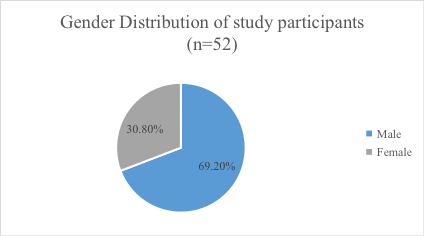
A total of 52 participants responded to the gender question. Among them, 36 participants (69.2%) identified as male, and 16 participants (30.8%) identified as female. This indicates a significant gender imbalance in the sample, with male participants forming more than two-thirds of the total population. The unequal distribution suggests that the study findings may be more reflective of male perspectives or characteristics, and caution should be exercised when generalising results across genders. (Figure 1)
Out of the 52 participants, 49 individuals (94.2%) reported that they do not use tobacco products, including cigarettes and chewing tobacco, while only 3 participants (5.8%) admitted to using them. This indicates a very low prevalence of tobacco use within the study population. The overwhelmingly non-tobacco-using sample suggests a generally healthy behavioral trend among participants regarding tobacco consumption. However, the presence of a small proportion of users highlights the need for continued awareness and prevention strategies targeting tobacco use.
Among the 52 participants, 47 individuals (90.4%) reported that they do not consume alcohol, while only 5 participants (9.6%) admitted to alcohol consumption. This reflects a low prevalence of alcohol use within the study population. The findings suggest that the majority of participants abstain from alcohol, indicating a predominantly non-drinking demographic. However, the presence of a small percentage of alcohol consumers highlights the importance of including alcohol-related behavioral awareness in health education initiatives.
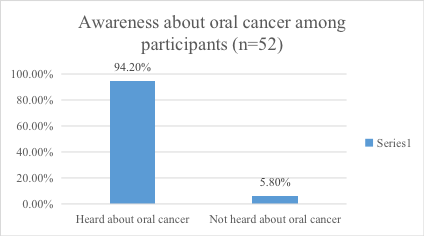
Out of 52 participants, 49 individuals (94.2%) reported that they have heard about oral cancer, while only 3 participants (5.8%) indicated that they had not. This shows a high level of awareness about oral cancer among the study population. The findings suggest that information regarding oral cancer is widespread and has likely reached a large portion of the public, possibly through health education, media, or academic exposure. However, the fact that a small number of individuals were unaware highlights the ongoing need for community-level awareness programs to achieve complete outreach. (Figure 2)
Among the 52 participants, the majority identified tobacco use as the primary risk factor for oral cancer. Specifically, 47 participants (90.4%) mentioned tobacco use, indicating a strong awareness of its harmful effects. Three participants (5.8%) identified poor oral hygiene as a risk factor, while 2 participants (3.8%) recognized alcohol consumption as a contributing factor. These findings reflect a high level of understanding regarding tobacco as a major risk factor, although awareness of other contributing factors such as alcohol use and poor oral hygiene was notably lower. This suggests the need for more comprehensive public health education that includes all major risk factors associated with oral cancer.
Out of the 52 participants, 47 individuals (90.4%) were aware that regular dental check-ups can aid in the early detection of oral cancer, while only 5 participants (9.6%) were not aware of this fact. These findings indicate a high level of awareness among the study population regarding the preventive and diagnostic value of routine dental visits in identifying oral cancer at an early stage. However, the presence of a small percentage of unaware individuals highlights the need to further promote the role of dental professionals in oral cancer screening through community outreach and education.
Among the 52 participants, 6 individuals (11.5%) reported experiencing unusual symptoms in the mouth—such as sores, lumps, or discomfort—that lasted longer than two weeks, while the remaining 46 participants (88.5%) did not report such symptoms. These findings indicate that a small portion of the population may have experienced potential early signs of oral health issues, including those possibly related to oral cancer. Although the majority had no such complaints, the responses emphasize the importance of awareness regarding persistent oral symptoms and the need for timely dental consultations when such symptoms occur.
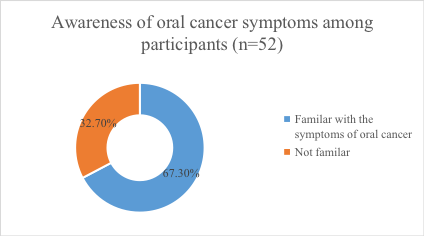
Out of 52 participants, 35 individuals (67.3%) reported being familiar with the symptoms of oral cancer, which include persistent mouth sores, unexplained bleeding in the mouth, difficulty chewing or swallowing, and lumps in the neck or oral cavity. The remaining 17 participants (32.7%) indicated that they were not familiar with these symptoms. While the majority demonstrated awareness of key clinical signs, a considerable portion lacked this essential knowledge. These results highlight the need for enhanced public education and awareness campaigns focused on the early warning signs of oral cancer to promote timely diagnosis and treatment. (Figure 3 )
Among the 52 participants, 21 individuals (40.4%) reported that they never visit a dentist for routine check-ups, highlighting a significant gap in preventive oral healthcare practices. 15 participants (28.8%) stated that they visit the dentist less than once a year, while 7 participants (13.5%) reported visiting the dentist once a year. Only 9 participants (17.3%) followed the recommended routine of visiting a dentist every 6 months. These findings indicate that a majority of the population either delays or completely avoids regular dental visits, which may lead to missed opportunities for early detection of oral health issues, including oral cancer. The data underscores the need for increased public awareness about the importance of regular dental check-ups in maintaining overall oral health and early disease prevention.
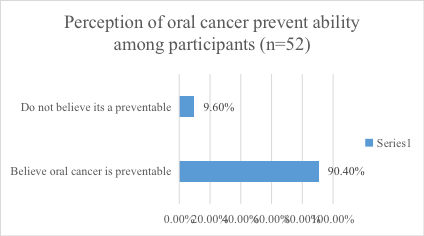
Out of 52 participants, 47 individuals (90.4%) believed that oral cancer is preventable, while only 5 participants (9.6%) did not share this belief. The high percentage of participants who consider oral cancer preventable reflects a positive level of awareness regarding the role of lifestyle choices and early detection in reducing oral cancer risk. However, the presence of a small proportion of participants who are unaware of its preventability indicates a need for further public education on modifiable risk factors such as tobacco and alcohol use, as well as the importance of routine oral health screenings. (Figure 4)
Among the 52 participants, 33 individuals (63.5%) expressed willingness to undergo regular oral cancer screenings, while 19 participants (36.5%) were not willing to do so. Although the majority showed a positive attitude toward regular screenings, a substantial proportion remained hesitant or unwilling. This highlights the need for increased motivation and awareness regarding the benefits of early detection through routine screenings. Addressing barriers such as fear, lack of knowledge, or perceived necessity could help improve participation in preventive oral health measures.
All 52 participants (100%) agreed that oral cancer awareness programs are necessary in their community. This unanimous response highlights a strong collective recognition of the importance of education and outreach related to oral cancer. The result suggests widespread support for initiatives aimed at increasing public knowledge, promoting preventive behaviors, and encouraging early detection. Such findings reinforce the need for implementing community-based oral health programs to address gaps in awareness, screening, and preventive care.
Out of 52 participants, 9 individuals (17.3%) reported having a family history of oral cancer or other forms of cancer, while 43 participants (82.7%) stated that they did not. This indicates that a small yet significant proportion of the study population may have an elevated risk of cancer due to familial factors. The presence of a family history in nearly one-fifth of the participants underscores the importance of targeted awareness and preventive strategies for at-risk groups, including genetic counselling and more frequent screening. These findings also highlight the need to include family history as a routine part of oral cancer risk assessments.
Discussion
The present study reveals that young adults are highly aware of oral cancer since 94.2% of participants knew of the disease and 67.3% knew major symptoms like persistent lumps and sores. Most identified tobacco use as being the central risk factor (90.4%), while few were aware of the other contributors, which do include poor oral hygiene as well as alcohol consumption. These findings align with what researchers found across India and South Asia, where population surveys also report that people widely regard tobacco as the leading risk factor, but they often do not completely know other risk factors and symptoms (7) (8) (9). Thorough awareness levels are sometimes substantially lower in rural settings as well as among university students. These findings are in contrast with other studies which suggest regional and demographic differences (9). The study does reveal that a gap exists between knowledge and preventive practices despite good awareness. Just 17.3% said they visit the dentist every six months, but 40.4% did not seek regular check-ups. Research from both local with global settings echoes this, observing preventive health behaviors lagging behind knowledge, commonly because of motivational together with social obstacles (10) (9).
The willingness to participate in oral cancer screening (63.5%) seems fairly hopeful, but some people still resist because it shows continuing attitudinal barriers like those seen in earlier work (9). Notably, all respondents agreed about the need for oral cancer awareness programs because that reinforced a strong community interest in targeted education and outreach. Family cancer history among 17.3% of participants highlights prevention strategies tailored for high-risk groups a point raised repeatedly in the scientific literature (7) (10). In general, such results align to earlier research, and this indicates a need of a thorough public health intervention that promotes not just awareness, but it also promotes active behavioral change (11) (10). Future strategies must prioritize oral cancer education along with routine screening to improve early detection and lower disease burden in India and similar high-risk regions (11) (9). The strategies must also reduce tobacco as well as alcohol use for achieving this goal.
Conclusion
This study highlights the fact that participants happen to be aware of oral cancer. Most people noticed some key symptoms. Furthermore, they knew the disease was avoidable. Despite this, tobacco as well as alcohol use remain common since a gap exists in knowledge and behavior. Regular dental check-ups that are vital for early detection were reported by only a few of the respondents.
Findings about awareness of risk factors were encouraging. Willingness toward screening was also encouraging. From across the globe and even from India, the results do align with the previous research.
In conjunction with education, public health efforts must now focus on the promotion of behavioral change.
References
- World Health Organization. Global Cancer Observatory (GLOBOCAN) – Oral Cancer Statistics. Google Scholar ↗
- Warnakulasuriya, S. Causes of oral cancer – an appraisal of controversies. Br Dent J 207, 471–475 (2009). DOI ↗ Google Scholar ↗
- Newell Johnson Journal of dental education 65 (4), 328-339,2001. DOI ↗ Google Scholar ↗
- "R Sankaranarayanan Oral surgery, oral medicine, oral pathology 69 (3), 325-330, 1990” . DOI ↗ Google Scholar ↗
- Poul Erik Petersen Community dentistry and oral epidemiology 33 (6), 397-399, 2005. DOI ↗ Google Scholar ↗
- Kshipra Deshpande, Sanmay Parakh, Kiran Jadhav Indian Journal of Multidisciplinary Dentistry 9 (2), 100-105, 2019. DOI: DOI ↗ Google Scholar ↗
- Kavita P Ahluwalia .Published in final edited form as: Cancer. 2005 Dec 15;104(12 Suppl):2959–2961. doi: DOI ↗ Google Scholar ↗
- Wenhua Xu, Chenxi Li, Qingqing Liu, Wei Liu, Xiao WangJournal of Dental Sciences 19 (4), 2157-2162, 2024. DOI ↗ Google Scholar ↗
- EA Shanika D Somathunga, DM Sithara H Dissanayaka, DR Dilini L Ratnayake, Ruwan D Jayasinghe Asian Pacific Journal of Cancer Care 6 (1), 47-51, 2021. DOI DOI ↗ Google Scholar ↗
- AG Deepa, G Indu, S Sudha, G Nair Resmi South Asian Journal of Cancer, 2024. DOI: DOI ↗ Google Scholar ↗
- Nidhi Saraswat, Rona Pillay, Bronwyn Everett, Ajesh George BMC cancer 20 (1), 477, 2020. DOI ↗ Google Scholar ↗