Abstract
This study explored the lived experiences of ESL learners’ in language acquisition to further understand how they make meaning of said experiences in respect to the factors that influenced them, the challenges they encountered, the coping mechanism they utilize, the emotion they navigate, the language exposures they engage in, and the ways it shapes their evolving cultural, social, and academic identities. Triangulating the collected data through one-one-one interview, Focused Groups Discussion (FGD), and Content Analysis of Language Learning Journals; and, checking the results’ validity through member checking with 8 purposely selected participants, the study found out through a hermeneutic analysis that ESL learning is influenced by media exposure, social interactions, and role models. The process is often motivated by encouragement, and the desire to fully learn the language as it is seen to forge global connectedness. As the study explored how language learning aid in identity formation and achieving sense of belongingness, it was found out that cognitive (struggle for accuracy) and affective (fear of being judged, frustrations, and low self-esteem) challenges are experienced by ESL learners often leading to withdrawal and avoidance from participating in communication tasks. Additionally, ESL learners who fully acquired the English language may also experience confusions with their bilingual identity as they find it hard to place themselves in either of the linguistic settings. As learners see the English language as means for social validation and positioning, it is often considered as economic capital that may lead to the success or failure of their future life prospects. The study came up with the Conceptual Model on Identity Formation and Social Positioning in ESL Learning that is recommended for further integration and analysis through applications, and future researches.
Keywords
ESL Acquisition ESL Education ESL Learning in the Philippines ESL Learning Model Language Education
Introduction
English is recognized as the universal language allowing people from all over the world to communicate and build connections. Over time, English spread across different aspects of Filipino society, including education, media, governance, and science—making English language acquisition a central component of national life. It continues to hold a privileged status, as proficiency in ESL enables Filipinos to engage in the global market and remain competitive in various professional fields (Manalastas, 2022). Understanding the 21st Century needs for global interconnectedness, the Philippine’s Education System witnessed a refocus on English as a Second Language (ESL) learning through the Republic Act no. 12027 and DepEd Order No. 20, series of 2025 mandating that English should be brought backas the primary medium of instructions from grades 1-3 (Sampang, 2024; DepEd, 2025). The shift from Mother Tongue-Based Multilingual Education to the restoration of English as the official media for instruction was meant to shape learners to be better ESL users. However, despite of Filipinos’ early exposure to the language, ESL acquisition can still be challenging to some as the process can be affected by different factors that can either motivate or hinder their learnings.
Language learners face various challenges when learning ESL including, but not limited to, linguistic difficulties (Alimorad & Adib, 2022; Ameen & Najeen, 2023; Aporbo, 2024), cognitive challenges (Cai, Fei, & Song, 2023), and emotional and psychological ordeals (Wolf and Phung, 2019). The process was also influenced by different factors such as culture (Cao, 2018) and individual differences (Qiao, 2024). These shortcomings in language use lead learners to have the feeling of inadequacy and low self-esteem leading to self-doubt making it hard for them to acquire the target language (Alimorad & adib, 2022; Ambunan et al., 2022; Isma et al, (2023). Dilnoza (2023) emphasized that these difficulties are frequently compounded by educational systems that prioritize written grammar exercises over communicative competence, leaving learners hesitant to engage in speaking and real-life communication.
When considering local context, a phenomenological study by Aporbo (2024) highlighted common challenges among Filipino ESL learners, including difficulties with pronunciation, grammar, reading comprehension, and self-confidence. These issues are often linked to language anxiety and limited exposure to English. Learners cope by expanding their vocabulary, reading more, practicing speaking, and seeking help from peers, teachers, or online resources, demonstrating their resilience and commitment to improving proficiency. Cailao and Diva (2024) emphasized that Filipino ESL learning involves both cognitive and emotional processes. Learners experience insecurity, anxiety, and pride, yet actively employ strategies such as self-directed study, regular practice, and technology-assisted learning to navigate challenges. The study underscores the importance of teaching approaches that support learners’ well-being alongside academic development. Similarly, Aron-Salvacion (2023) explored Senior High School students’ experiences with English as the medium of instruction. While learners recognized the benefits of English for vocabulary expansion, communication skills, and future opportunities, they reported challenges such as speaking anxiety, fear of mistakes, and difficulty with fast-paced discussions. They highlights the need for structured practice opportunities and supportive classroom environments to build confidence and competence.
Drawing from Krashen's Second Language Acquisition Theory (1982), the study explored how learners are emotionally triggered by SLA process and how they are affected by low and high affective filters. The study was also guided by Kolb's Experiential Learning Theory (1984) in treating experiences as part of the language learning process focusing on how learners participate and reflect on language learning experiences and eventually apply these realizations in new situations and contexts. Vygotsky's Socio-Cultural Theory (1978) underscore the role of collaboration, interaction, and guidance from teachers or more skilled peers in supporting student growth. At an early stage, learners depend on external assistance (scaffolding), but over time they develop the capacity to complete tasks independently (Allami, Najari, & Tajeddin, 2025). This theory guided the study as it sought to explore how language learning is influenced by social interactions and meaningful connections. Exploring how social relationships influenced SLA assisted in the understanding of language learning as social process. As the study saw SLA as a social process, it was also seen as a medium for identity formation leading back to learning investments as proposed by Norton's Theory of Identity and Investment (1995). In this context, second language learning is seen as new means of self-representation in the new community hence influence them into committing in using the TL (Chang, 2016). On the other hand, Pavlenko's Narrative and Emotion on Bilingualism Theory guided the study by aiding it in the exploration of the emotional and narrative aspect of language learning. This includes the understanding of how learners' emotion and narrative form their language use as well as their identity.
Despite extensive research on English language acquisition in the Philippine context, second language acquisition processes, theoretical frameworks, cultural influences, emotional and psychological factors, and the effectiveness of teaching methods and materials, there remains a critical gap in understanding the lived experiences of ESL learners themselves. Most studies provide quantitative data, theoretical explanations, or broad classroom observations, but they do not fully capture how learners perceive, interpret, and make meaning of their own language learning journeys. For example, research on teaching methods and materials highlights which approaches improve proficiency (Kiran & Baig, 2021; Dewi et al., 2025; Umar, 2024), but does not reveal how students personally experience the challenges, successes, or frustrations associated with these methods. Similarly, studies on cultural and psychological factors identify trends in motivation, anxiety, or social interaction (Tuncel et al., 2020; Wu et al., 2022; Al‑Khresheh et al., 2025), yet the subjective, nuanced ways these factors influence daily learning experiences remain underexplored. Understanding ESL learners’ lived experiences can provide insights into how theoretical constructs like Universal Grammar, communicative competence, or task-based learning manifest in real-world contexts. Moreover, phenomenological inquiry allows educators and policymakers to design more learner-centered programs that align teaching strategies with students’ actual needs, perceptions, and cultural realities. Therefore, studying the lived experiences of ESL learners in SLA is necessary to complement existing knowledge, humanize language learning research, and provide a holistic understanding of how learners engage, struggle, and succeed in acquiring English as an L2.
In view of this, the main purpose of the study is to explore the lived experiences of ESL learners in their journey in second language acquisition and understand how they make sense of said experiences in respect to factors that influenced them, the challenges they encountered, the emotions they navigate, the language exposure they engage in, and the ways these shape their evolving cultural, social, and academic identities. The study also aimed to draw insights from these experiences to inform pedagogical practices in ESL education.
Methodology
The research focused on the exploration of the lived experiences of ESL learners in language acquisition through a hermeneutic-phenomenological research design. Phenomenology, as a qualitative research approach, focuses on the exploration and understanding of the lived experiences and the meaning of these experiences for an individual. It deals with the understanding of how a person perceive, interpret, and make sense and meaning of their experiences (Gallagher, S., 2022). In this type of approach, when the researcher refrains from the use of epoche and focuses on the interpretation of said lived experiences, hermeneutics is applied (Kakkori, L., 2009). This method combined phenomenological descriptions of lived experiences by the respondents with the interpretative analysis of the researcher for deeper understanding of human experience. Drawing from van Manen’s (1997; 2023) and Gadamer’s (n.d.) concept of hermeneutic analysis, the research interpreted the lifeworld and meanings of lived experiences recognizing that it is shaped by social, cultural, and historical context. In the attempt to understand said experiences, hermeneutic circle was performed by the circular process of interpretation and reinterpretation. The researcher was involved in a dialogue with the ESL learners whose experience is being interpreted and analyzed by identifying meaning units ultimately leading to the formation of themes.
The participants of the study were ESL learners who have fully acquired the English language. They were chosen because they can provide a more detailed and extensive experiences on the process as to how a language is acquired. By studying them, the researcher aimed a deeper understanding of the contextual factors that influence language acquisition. Since phenomenological study is not bounded by place and time, the participants of the study were eight (8) senior high school students from San Pablo City, Laguna, specifically at STI College San Pablo with the grade of 90 and above in their Grade 10 English average and their subject English for Academic and Professional Purposes (EAPP) during the A.Y. 2025-2026. As senior high school was designed to prepare students for their desired courses in college, this population was chosen as they can give insight on what is the experience of ESL learners during an importance phase and time of their language acquisition. To ensure that this study adheres to the principles of ethical research and to guarantee protection of the well-being the participants, the researcher obtained an informed consent from the participants. Participants’ permission was also secured before the audio recording of the interviews and group discussions as well as the safe-keeping and storage of said recordings. For the protection of the participants’ privacy and identity their data are anonymized and pseudonyms are assigned to them in write-ups. In cases that they decide to withdraw from the study, they were allowed to do so at any time without any consequences. Support information was also provided to the participants given that emotional topics such as language related shame or traumas may arise from the interview and group discussions. These ethical considerations were crucial as they protect the rights and well-being of the participants, ensure the integrity and validity of the research findings, and maintain public trust in the research process.
The study made use of three research instruments. The first instrument is a Semi-Structured Interview Questionnaire guided with informed consent form. This was composed of open-ended questions that were answered with responses that led the researcher into asking more sets of questions entirely based on how the participants responded. This was designed to explore the experiences of ESL learners in English language acquisition. Since semi-structured interviews let the researcher ask follow-up questions, it also allowed flexibility in questioning, enabling them to probe and explore emerging themes. As it was participant-centered, it empowered participants to share their lived experiences and perspective on their own words. The instrument for this study focused on the life history of the participant as well as their language biography focusing on how they first engaged in English, turning points, and meaningful episodes. To enhance its reliability and appropriateness, it was content validated internally by four internal experts and externally by three English language teachers who were in service for at least three years. A structured Language Learning Journal was also used by the researcher to encourage participants to reflect and analyze their own experiences, offering the researcher insights into the metacognitive process involved in SLA. To ensure the categorization of data, the researcher provided specific prompts and guiding questions to make sure that the entries revolved only on actual experiences related to the study’s point of inquiry. The researcher also made use of an Focus Group Discussion (FGD) Guide. This was created based on the statements and responses provided by the participants in the one-on-one interview and their narrations in their learning journals. This was designed by developing a semi-structured outline of open-ended questions meant to explore significant statements by the participants. Key themes and remarkable points were identified by the researcher from the result of the interview as an attempt to give focus to significant experiences in language learning the participants shared. The guide was a flexible tool allowing the researcher to probe deeper into the participants’ responses by focusing on the answers they gave during the actual FGD, not just on the prepared questions alone. Within this three tools for data collection, the researcher incorporated the use of a research code book. The research code book was a guide that the researcher used to identify meaning units from the responses of the participants. It is like a dictionary that defines category used in analyzing the data, including the inclusions and exclusions of said category to better identity and highlight key experiences written by the participants. Although it is also used in the study as a tool for data analysis, it also acted as an important component of the research instruments as it kept the data gathering consistent, transparent, and organized making the research easier to be replicated by other researchers.
Employing the phenomenological approach to qualitative research and following Denzin’s conception of triangulation, the study gathered multiple qualitative sources to strengthen interpretive depth and conformability and ensure that it is grounded in data. The study was performed through In-depth semi-structured interviews, use of Reflective Learning Journals, and FGD. The study conducted two semi-structured interviews per participant. The first interview focused on the life history of the participants as well as their language biography focusing on how they first engaged in English, turning points, and meaningful episodes. The second interview was for member-checking opportunities meant for follow-up clarifications and reflection following the initial analysis. To support the results of the interview, the participant wrote journal entries narrating their experiences in language acquisition with prompts focusing on salient learning moments, frustrations, successes, emotional responses, and imagined futures. These journal entries were analyzed and interpreted along-side the result of the semi-structured interview to strengthen the data analysis. After analyzing the data gathered from the semi-structured interview and reflective learning journal writing, participants were invited for small group discussions online to explore shared experiences and social dynamics. This gave the researcher the opportunity to triangulate individual narratives with collective accounts uncovering how shared dialogues and social interaction assist in shaping the understanding of lived experiences in a manner that may not appear in individual interviews and journal entries. Following these methods of triangulation, the data gathered and analyzed led the researcher into forming themes to better understand the participants' lived experience in language acquisition.
Using the Hermeneutic procedure in exploring and analyzing a phenomenological data, the research followed these steps for data analysis. The first step is Transcription and Immersion. The researcher transcribed the data from the semi-structured interview, the learning journal logs, and the FGD, verbatim. The transcription process served as the first re-familiarization of the researcher to the raw data. They then immersed themselves to the data by repeatedly reading the transcription for familiarization and to develop a holistic sense of the data at hand (van Manen, n.d.). It was done by reading the transcription the first time while highlighting parts of the statements that seems relevant. After the first reading, the researcher read the transcript the second time after taking a short break. This break allowed them to detach themselves from the data so that for the second reading, they could see it in a fresher perspective. During the second reading, the researcher paid close attention on the highlighted statements, reconsidering them along with the other parts of the transcript for additional highlighting of significant statements that they missed the first time. Then, the researcher read the data the last time to double check if there is no part of the transcript and journal logs that they missed. By doing so, the researcher was able to make sure that all significant statements of the participants were captured. The researcher then performed the Hermeneutic Circle. The researcher moved back and forth between interpreting parts (i.e., phrases and episodes) and whole (participant’s life story) to refine the understanding of the meanings of the lived experiences. It was done by starting with the interpretation of individual parts. This was done by focusing on the highlighted parts and trying to interpret them on their own. The researcher then looked at the transcription as a whole to make relationships between the highlighted parts and its experiential contexts. The interpretation of the parts was used in the understanding of the whole. When the researcher saw the concept in a whole-level interpretation, they then revisited and re-examined the individual parts and revised them if necessary. The revised parts were then used to update the understanding of the whole. This cycle was repeated until there is sufficient development within the researcher’s interpretation (Gadamer, n.d.). The third step is performing the Thematic Interpretation. After the researcher identified significant statement seen to be capturing the essence of the experience being studied, they assigned them with descriptive labels in form of meaningful units that represents the central meaning of the idea. They then generated theme by looking for pattern and/or connection among the meaning units. Said meaning units were grouped according to categories and along the process, the researcher analyzed and reconsidered them making sure that the meaning units belonged on their assigned theme. In identifying the responses of the participants, a code-assigning pattern is made by the researcher. For interview excerpts, the researcher followed these code-assigning patterns: I.P1.p3.1-2, where I stands for interview, capital P+numerical digit represents the participant and their assigned number, lowercase p+numerical digit represents the page number and digits in form of ranges to represent line number/s; FGD.P1.p3.1-2, where FGD stands for Focused Group Discussion, capital P+numerical digit represents the participant and their assigned number, lowercase p+numerical digit represents the page number, and digits in form of ranges to represent line number/s; and, J1.P1.1-2, where Capital J+numerical digit stands for Journal entry number, capital P+numerical digit represents the participant and their assigned number, and digits in form of ranges to represent line number/s. The researcher the did Triangulation and Convergence Checks. Once themes were created and interpreted, the researcher proceeded to cross-case synthesis by comparing themes across the study's different data sources such as interviews, reflective learning journals, and FGD. The researcher went back to each data source carefully looking for similarities in statements and themes. Themes were also compared across participants in an attempt to identify recurring patterns and points of divergence (Denzin, n.d; Patton, n.d). The researcher then combined and grouped together the meaning units from all three different data sources allowing them to come-up with unified themes that best describe the experiences of the participants. And finally, Member Checking and Reflexivity was performed with the participants. The researcher shared emergent interpretations to the participants for member-checking giving them the opportunity to give feedback and check the results for accuracy and resonance. This included, checking of initial theme formed, allowing the participants to review statements, meaning units, and thematic interpretation to give feedback to the researcher. Once the researcher came up with the final theme table, they went back to the participants for another round of member checking to make sure that the interpretation resonates with the actual experience of the participants. The researcher also kept a reflexive journal documenting their personal thoughts, biases and preconceptions, interpretative choices, and reactions through-out the research process.
Results and Discussion
This study explored the lived experiences of ESL learners in their journey in second language acquisition and understand how they make sense of said experiences in respect to factors that influenced them, the challenges they encountered, the emotions they navigate, the language exposure they engage in, and the ways these shape their evolving cultural, social, and academic identities. The study also aimed to draw insights from these experiences to inform pedagogical practices in ESL education.
The Phenomenological Analysis of the collected data reveals insight into the participants’ lived experiences in ESL acquisition. The data provided by the participants were carefully checked and analyzed to find meaning units. These meaning units were then grouped into categories to form themes that authentically and truly reflects the essence of the learners' lived experiences. Themes were then reviewed and reconsidered to ensure the accuracy of the result. In doing so, the researcher involves the participants through member checking. This is to maintain the shared interpretation between the subject and the proponent of the study. The data from the study revealed six themes on the significant experiences the learners have.
Theme 1: Empowerment as Motivation Fueling Language Acquisition
This theme highlights different ways in which ESL learners became motivated to acquire the language. It involves both intrinsic and extrinsic motivators acting as contributing factors to the success of language learning. As an extrinsic factor, the category Drive Fueled by Encouragement emphasized the important role played by positive feedback and encouragement from others on the ESL learner's motivation and confidence to learn the language. The participants attributed their eagerness in language acquisition to the motivation peers and educators give them. They highlighted how recognition from teachers enhances their self-esteem and fuels their desire to improve their language skills and ultimately acquire the target language (TL). The experiences related to being complimented and seen act as affective motivators transforming external validation into internal drive to practice and strive for proficiency. Language teachers’ gestures of reassurance act as a form of encouragement giving learners courage to not worry about judgment. Praises and compliments also play a crucial role in motivating them to aim language proficiency. Experiences with positive feedback such as praises and compliments as well as both verbal and non-verbal motivations allow them to move along with their language learning in a more driven and eager manner. When language learners are reassured when trying to use the TL, it enhances their participation and eagerness to commit in conversation without fear of judgement. It therefore shows that learners who are trying to acquire a second language are assisted by these external, affective factors during the process. Such extrinsic motivators allow learners to feel seen and appreciated hence they constantly look for affirmation from their social connections to help them keep on committing to their ESL learning journey. Recent studies consistently demonstrate how encouragement function as a motivational force to language learning as it shapes learner's emotional, social, and psychological experiences in SLA. Solhi (2023) wrote on how teacher and peer support and reassurance significantly enhance second language learners’ participation on L2 use by fostering sense of belongingness and reducing anxiety. The said motivational effect is not just limited to direct and verbal form of encouragement. It also works through the connection of self-efficacy and peer support, indication that the creation of supportive learning environment which help sustain L2 motivation is influenced by encouragement from others (Wu & Cai, 2025). Complementing these findings, studies highlights encouragement as an emotional reassurance telling learners that their efforts are seen, that difficulties are normal, and that they should take risk—all crucial for language development (Peng 2021; Leis, 2021).
Another category generated from the study is Thirst for Learning Fueled by Ego. This explores the way on how the learner's ego and sense of competitiveness acts as intrinsic motivator in improving their language skills and proficiency. Participants recognized their Desire for Validation and Recognition as key motivating factor in their quest to language learning. They attested that their desire to be respected and taken seriously motivated them. Some pointed out that learning the language is something that they have to do to stand out or fit in. These show that learners see ESL as tool for belongingness. Mastering their L2 put them in a position where others see them as dependable and relevant. Because of the learners’ desire to belong and be accepted and be part of a space they deem acceptable, they also develop the desire to prove their linguistic skills to peers who wished to challenge them. They use their knowledge of ESL to prove themselves and to show that they have a place to take in the classroom as it gives them the sense of pride and accomplishment. Another motivation that they have in language learning is their Desire for Higher Social Standing which they try to reach by learning more to feel superior and prove themselves to family and friends. When they want to hold a certain image or perception from others, they resort to ESL learning and usage. They utilize it as means to show people what they can do and what they are capable of, to hold a position within social context, and to secure respect and validation from others. As they view English as a tool for securing validation and recognition, they developed a strong willingness to engage in ESL use. Bao and Liue (2021) investigated the role of affective factors, such as pride, to the eagerness of second language learners. Their study highlights how motivation and engagement in language learning is affected by positive self-evaluation, including pride and ego. They argued that learners who experience pride in language learning are more willing to take part and take risk in a conversation. They are also more persistent when facing learning difficulties and challenges. This claim is supported by Khajavy and Lüftenegger (2024) who explore how pride plays a motivating role in language learning. Findings revealed that pride positively affect the learners' motivation, engagement and willingness to use and communicate with the TL. They argue that pride improve learners' sense of achievement and self-worth which motivates them to make and sustain efforts and continue investing in language learning. These shows how pride act as an ego-affirming emotion which act as a powerful motivation in ESL acquisition. It reinforces learner's confidence and reduce fear of failure in second language learning.
Theme 2: Learning English through Exposure and Interaction
This theme highlights the influencing factors on how ELS learners acquire the TL. Media as a Language Teacher is recognized by the learners as one of the influences that help them acquire the language better. Exposure to media as language learning motivator is an important part of their language learning process as linguistics skills are acquired from English books, TV shows, and movies. Aside from being a motivation and setting linguistic examples, they also see media take the role of mentor and companion as most language learners see it as their first language teacher allowing them to play-pretend in communicating with fictional characters at a young age making ESL learning feel natural and authentic. Moreover, ESL learners adapted conversational elements and technical requirements in the use of the language from imitating English media. They pick up patterns and expressions from English contents and use them in day-to-day conversation—a practice that leads to ESL acquisition. When ESL learners are exposed to English-centered media, they find it easier to learn the language as said exposure made them perceived the language learning as authentic and natural. Regular engagement to such media contents made learners see fictional people and characters as real language users allowing them to see them as language mentors and companions making them learn through imitation and mimicry. In support to this, Roslim et al. (2021) examined the role of English movies in language teaching and learning. They found out that other than classroom instruction, movies function as effective language input. Exposure to media, such as movies, provide learners the opportunity to acquire new vocabulary, improve pronunciation, and understand natural and authentic conversational patterns in the TL. They also found out that learners find movies as informal language teachers as they provide real-life language modeling leading to reduced anxiety and increased learning motivation. The authors concluded that movies enable learners to learn naturally by continuous and repeated exposure giving them the chance to imitate natural and realistic conversations and linguistic patterns in meaningful real-life context. Nikmah and Dzulfahmi (2020) also explore the role played by movies in language learning. They explained how movies provide the same language input as textbooks and other written materials. It also acts as primary source of vocabulary learning among ESL learners. Similar to other narrative texts, learners acquire new vocabulary from movies through the exposure to dialogue, context clues, and visual supports.
Another category generated under this theme is Language Learning from Social Influences. This tackles how ESL learners are motivated to learn the language by their social environment including family, friends, and peers. Social connections and conversation serve as language practice. The presence of individuals that are fluent in the language provide learners opportunity to practice their learning and skills through natural, day-to-day communication. Communication with family and friends in the English language contributes to the improvements and developments of the learners' language use. When the English language is regularly used by the learners in conversing with people around them, they were allowed to bring the learnings they have in the classroom in real life instances. Paradowski et al. (2021) found out that learners who interact with peers actively exhibit greater development in the TL particularly in oral communication. They argued that learners with enough exposure and interaction with peers have better learning opportunities as they are provided with avenues to negotiate meaning and to utilize the language. They continued by saying that language peers function as significant social agent in language learning as frequent interaction with them provides authentic communication and allows learners to sustain engagement and connections using the TL.
Language learning can also be driven by positive social environment. Exposure to peers who are comfortable with the language aid in the development of learners’ speaking and verbal communication skills. As such, the process of language acquisition is greatly influenced by the presence of positive external factors such as environment and peers. The presence of these factors aide language learning through giving the learner a comfortable avenue to practice and use the language, ultimately leading to language acquisition. The willingness and perseverance of L2 learners came from their perception of their social interaction. Their readiness to communicate the English language is based on the positive peer relationship and cooperative interaction. This is supported by Han and Li (2025) as they wrote that L2 learners who have positive and supportive social environment shows more willingness to speak, share ideas, and participate in meaning-focused tasks in the target language. Social interaction acts as language learning tool as it encourages active use of the language and facilitate the reduction of communicative anxiety.
Another factor influencing language acquisition is Familial Recognition of Potentials and Opportunities pertaining to the way on how parents and family recognize the advantages English could bring to one's life, influencing learners to learn the language more. Family influenced ESL learners to learn the English language by letting it be known that it hold the power for them to achieve a better future. In countries like the Philippines, people see English as a door to greater opportunity to work outside the country. For that reason, Filipinos give importance to acquiring the English language as it is seen as investment for future career paths. 2021, Pagulayan et al. (2021) found out in their study that families with higher educational aspirations view English proficiency as a cultural capital that can be used by learners in academic and professional success. Parents who hold this view support and motivates their child more towards ESL acquisition. This view towards English made learning more meaningful as efforts and hard work promise leverage in future endeavors. In support to this, Gapasin (2024) examined the factors influencing ESL learners' motivation in learning ESL and it found out that family support plays an important role in sustaining ESL learner’s motivation. In further emphasize that learners with families who see English as academic tool for success and employability demonstrate higher level of participation and engagement in language learning.
Language learners also resort to Seeking Inspiration and Role Models. In language learning, learners acknowledge the role played by external contributors to their learning journey. Teachers, parents, and/or media personalities served as inspiration to ESL learners trying to improve their English language skills. The role of language teachers is not limited to just teaching actual language lessons. It goes beyond the discussion in the classroom. Students and learners look at them as figure of authority with huge influence to their language learning journey. ESL learners also take inspiration from the influence and recognition of their parents' skills. Also, being exposed around a parent that has a good command of the TL inspires learners to learn and acquire the language better. When learners are exposed to the language at home, it became easier for them to commit to learning the language as it feels more natural and familiar. In some cases, when learners look up to their parents and identify them as capable language, they see language learning means to connect to them. In learning ESL, inspiration could also come from acknowledging skilled and capable peers. Language learners form admiration towards peer whom they see as capable TL users and see them as inspiration to learn more. This shows how language learners see peers as connections leading to learning opportunities. They get the feeling of admiration towards such individuals. They acknowledged how the presence of people with the skill and ability with the language plays a role into motivating them to work harder in able to learn the language better. Their presence and ability made them eager to learn the language more and making connections with them is seen as a chance to practice the use of the language. In connection, Bailey and Fahad (2021) argue that language learners drew inspiration from role models present in the community or other accessible and broader society. These role models help tem visualize the type of L2 language they wanted to be. Interaction and connection, whether direct or indirect, with these role models lets the learners see future versions of themselves as English language users. The opportunity to see what they may be as ESL speakers leads them to commit more to language learning. The presence of this role models helps learners connect themselves to their learning aspirations and real-world possibilities making the language learning more purposive and sustainable.
Theme 3. English as a Bridge to Connection and Identity
This theme presents how English language acquisition enables learners to connect with others, build relationships, and solidify their sense of identity. Participants view English as a Bridge to Global Connections. It enables them to connect with people with diverse cultures and backgrounds leading to global understanding and relationship. These put emphasis on how the participants see English as this very tool to interconnectedness. Having English as the one medium everyone in the world is supposed to understand, it became easier to communicate for speakers from different country using the said language. The language's versatility allows them to communicate with people with diverse cultural backgrounds from places around the world. Recognizing this ability of the English language inspires ESL learners to aim for acquisition as it gives them opportunity to reach places. Through the language, cultural-sharing, globalization, and global interconnectedness became easier. Having one common language to use with people from different geographical backgrounds leads to sharing of ideas, culture, and dialogues building friendship across the world. Higgins (2024) supported these findings by stating that English act as a bridge for interconnection allowing speakers to build global friendships across different cultural boundary. The language allows learners from different places to engage in intercultural dialogue, share and negotiate meanings, and commit in problem-solving situations.
Participants also recognize English as key to cultural understanding. The language allows them to connect with different culture leading to global understanding. They use English to communicate with people with different cultural background ultimately leading to understanding those cultural contexts. Global connection is seen by learners as that which requires one universal language that will make it easier for people to access and understand. In that case, the presence of the English language in their attempt of global communication made it possible to connect with people from any part of the world as English is seen by the participants as language unifier. Language learners see the ability of the English language to connect and unify people from different linguistic and geographical backgrounds. By saying so, the said characteristics of the language allows users to forge connections. Seeing English as a language that can be understood even by non-speakers leads learners to the appreciation of the language's ability to connect them to the world. Acknowledging the potential of English to assist them in global connection contributes to the desire of learners to acquire the language effectively. Salih and Omar (2021) examines the role of English as universal language focusing on how it facilitates intercultural communication among students from different cultural and linguistic backgrounds. English act as shared medium to learners allowing them to exchange ideas and collaborate as well as challenge and clear cultural misconceptions whether in online or academic setting. As English allows them to keep sustained interaction, they developed greater cultural awareness and openness to global differences and diversity having the language act as bridge that enables meaningful global connections. Participants stated that knowing how to use the English language allows them to connect with foreign friends that ultimately affect and strengthen their bonds. Friendship among people who do not speak the same native language can be formed out of the use of the English language therefore mastering the said language is a key to interconnectedness. ESL learners maximize the use of English as the universal language by forging connection with co-English users from other parts of the world. By doing so, they were able to engage in dialogues that leads to cultural bargaining and understanding leading to established relationship with others. As Salih and Omar (2021) explore the use of English as global lingua franca allowing learners from parts of the world to form connections and cultural understanding, they established the role of the language as bridge and unifier. The language helps facilitate intercultural dialogues among speakers allowing them to build global friendship formed from expression and understanding.
English language also has the Power in Shaping Identity as language acquisition influences learner's sense of self in shaping and crafting identity towards belongingness. It helps shape learners' identity towards belongingness as it acts as tool for social positioning. ESL allows learners to create image that eventually helps others in identifying them. When ESL learners are trying to navigate their part and position in a societal context, they see their ability to use the English language as means of positioning themselves within a social group or space. Being able to know how to speak the said language gives them the feeling that they are capable of something that can make them connect with others. As they hold a medium for better and continued interaction, it allows them to create an image of themselves that can help others identify them ultimately allowing the learners to hold themselves as part of the community where they feel they have to belong. The learners’ perceived ability in ESL affect how they see themselves within a social circle. Their ability to use the English language authentically is closely related to their perceived power within their social interactions. When they feel that they are linguistically constrained or inferior, their sense of belonging within the community weakens. Therefore, English can serve as a gatekeeping language that can make learners feel empowered by experiencing social inclusion or make them feel outsiders within their circle thereby shaping their sense of identity and belongingness (Wang, 2021). This can shape how learners perceived themselves socially and academically. It can help learners position themselves as more confident, globally connected individuals. The language serves as symbolic resource helping learners negotiate their sense of belonging and identity over time (Abdusyukur, 2022).
Learners also use English as a Means of Social and Cultural Navigation as it enables them to navigate social situations and build relationships. Participants mentioned that they see English as a bridge that help them forge global connection making English as a relationship and connection builder. ESL learners utilize English as a tool to create meaningful relationships with people close and far from home. Mastering the English language is seen as a tool for social and intercultural connectedness allowing users to share one common sense of expression making understanding each other easier. The language's ability to connect users with different culture, beliefs, and backgrounds contribute to the creation of intercultural relationship among them. When used as a common language, English acts as relationship-building tool that make self-disclosure, dialogic communication, and development of shared meaning possible (Chang, 2021). The use of English among non-native speakers leads to the promotion of informal cooperation, increased tolerance and openness, reduced self-doubt and more motivated learners. The language helps learners sustain multicultural relationships by acting as a social bridge (Fomenko et al., 2021).
Theme 4. Challenges and Insecurities Bringing Struggle for Fluency in ESL Acquisition
This theme highlights the various challenges and insecurities that ESL learners face as they navigate the process of acquiring English language skills. One of the challenges and insecurities faced by ESL learner is The Anxiety and Fear of Being Judged. This captures the apprehension ESL learners feel when speaking English, particularly in formal or academic settings, due to fear of being judged or evaluated by others. Participants shared experiences with having jitters while speaking publicly. Even though learners are well versed with the language, when put in the situation where they have to use the language in actual situation, they may still feel uncomfortable about it leading to communication failure. That is because, when students are put in a situation where they have to speak publicly in the English language, they experience high anxiety level. This high level of anxiety is primarily caused by the fear of being evaluated negatively (Rahmat et al., 2021). The participants made mention that the nervousness stems from the fear of being evaluated. As learners report having to worry of being judged for errors in grammar, pronunciation, and their overall language competence, it is seeming that English can trigger strong emotional distress among them due to anticipated negative reactions from educators and peers (Rahmat, et al., 2021; Salameh, 2022). The participants also shared instances where the use of the English language has negative reception from people around them leading to their inhibition and fear to utilize it. Participants shared that they often refrain from speaking English because they experience moments where they were laugh at for simply using the language.
ESL learners also experience hesitancy with using the language because of the fear of being corrected and evaluated. Participants shared that using the language brings them overwhelming feeling of fear of correction contributing to heightened anxiety and uneasiness when asked to use the language. Language learners experience anxiety when using the English language because how they perceive how others may react towards their use of said language. Learners experience hesitancy when using the language at times where they believe they are in the situation where the people around them are capable of judging and evaluation their ESL fluency. They fear being judged and corrected as they associate it with shame and failure. However, it was interesting to find out that, there are instances that ESL users see their ability to use the English language as something that brings them shame. ESL use often leads other people to be judgmental towards the user as they associate it to acting superior or beyond one's expected capacity making language users feel that they should avoid the use of the English language as others may label them as different or out of the ordinary. This shows how the participants fear of public correction and evaluation act as an affective filter causing the learners hesitancy to in using the English language. This affective filter hinder learners form participating in authentic language use. It creates the feeling of nervousness, lack of self-confidence, and low self-assessment every time they try to use the language. This is supported by the study conducted by Nurilahi and Suhartono in 2022. They found out that fear of teacher correction and peer evaluation played a major role in stopping students from participating orally. As ESL learners reported experiencing anxiety when given evaluations and corrections immediately after a speaking task and being afraid of being laughed at and judged by peers, they concluded that evaluative classroom practices can intensify learners' insecurities causing them to be reluctant to use English even though they have ideas to share. The anxiety felt by ESL learners involves the loss of confidence and self-esteem. Committing a mistake when trying to utilize the TL leads to feeling of shyness rooting from the perception that peers find the learner's language use as inept. When language learners feel anxious about using the language, they tend to hold negative self-perceptions of their ability including fluency and communicative performance. Learners who experience higher level of anxiety may consider simple language mishaps as personal failure prohibiting them to participate more in a conversation leading them to have a limited social interaction in the TL (Linberg et al. (2022).
In language learning, students may have the tendencies of Suffering from Comparison and Self-Doubt. ESL learners compare themselves unfavorably to peers who are deemed more proficient and in command of the English language. This comparison leads to feeling of inadequacy and low self-esteem leading learners to question themselves and come up with the conclusion that they come inferior to said peer. It came to show that, when learning a second language, it is common for learners to compare themselves to other learners. As learners perceived that there are individuals more capable than them, it creates the feeling of insecurity leading them to question their own ability. They associated others language success as their failure. Language learners' views of others' linguistic ability affect their sense of self. Self-doubt usually stems from the feeling of inferiority from classmates whom learners perceived to be more fluent or accurate (Rahmat et al., 2021). When learners constantly compare themselves with other students, such feeling of inferiority sometimes affect their willingness to communicate more than their actual language proficiency (Hermagustiana et al., 2021).
Comparison does not only affect self-evaluation and self-image; it also has great impact in the confidence of the learners. When compared to other learners with better grasp of the English language, whether by others or by oneself, learners may experience decrease in the level of self-confidence that sometimes leads to the inhibition and avoidance of the use of TL. The feeling of being someone inferior to other learners ultimately leading to being overshadowed, bring affective response to learners causing them to question themselves and their own ability. Such feeling of inadequacy and self-doubt may lead to avoidance and withdrawal. When learners see themselves as inferior to others or incapable of a skill they deem important, they resort to withdrawing from or avoiding performing the said skills all together. According to Hermagustiana et al. (2021), when learners with low self-efficacy see others perform well in the TL, they more likely compare themselves to those peers and evaluate themselves negatively leading to the experience of heightened anxiety. This perceived inferiority will then lead to self-doubt that will then lead to limited self-confidence and willingness to communicate. This was supported by a study conducted by Inagaki (2022). It was found out that constant comparison with peers significantly lowered ESL learners' confidence in their ability in the language. When learners evaluate themselves against peer performance, they more likely experience the loss of motivation even when their actual performance and progress in satisfactory.
In case of language acquisition, having low self-esteem may lead to avoidance. In an experience with being face-to-face with a native English speaker, participants shared that, they experience hesitancy to communicate as they do not have the confidence to speak the language with a native. Withdrawal may also come from the fear of judgement. In instances where language learners sense that speaking the language may lead to the assessment of their skills, some resort to refuse the use of the language. When learners doubt their linguistic ability they are often found hesitating to volunteer answers, limiting their participation, or remaining salient during speaking activities. Learners may exhibit avoidance behavior but often times it is not coming from the lack of ability but rather from the fear of being perceived as incompetent by teachers and peers (Rahmat et al., 2021). According to Maher and King (2023), avoidance and withdrawal are coping mechanisms observable to learners with intense self-doubt. They were often seen silent during speaking engagements in classrooms--a response that is commonly seen as sign of disengagement but in reality is just a response to the feelings of inadequacy and fear of negative evaluation. In some cases, the same affective filters, such as frustration, leads to demotivation in learning. A participant, who shared to be an avid reader of classic novels, mentioned that in times where they find it difficult to understand complex terms in books, they would resort to just abandoning the book despite the level of interest they have in it. They even ended-up associating the language to failure leading them to stop enjoying the learning process. This proves that avoidance and withdrawal act as coping mechanism for learners who are experiencing language anxiety.
Aside from affective filters, cognitive factors may also hinder language acquisition. The participants shared how they struggle for accuracy when trying to use ESL. They shared being challenged by the inaccuracy in pronunciation, limited knowledge with the use of punctuation, and spelling. This shows that ESL learners struggle with different cognitive aspects of language learning. Since it is not their native language, challenges in pronunciation, vocabulary, and sentence construction may arise. These cognitive challenges may pose a threat to language acquisition as it could lead to the failure to learn the language fully. Also, these challenges may cause learners to be frustrated, question their ability, and feel insecure towards ESL use leading to decrease in performance and engagement. Recent studies show that challenges in pronunciation, spelling, and punctuation significantly contribute to ESL learners' reduced confidence and heightened insecurity both affecting their written and spoken performances. Learners who struggle with unfamiliar phonetic patterns are reported to fear negative evaluation leading to avoidance and hesitation of oral participations (Alimorad & Adib, 2022). Similarly, persistent spelling and punctuation errors affect learners' confidence and leads to the increase of anxiety towards writing tasks (Tambunan et al., 2022). This shows that challenges in pronunciation, punctuation, and spelling are all affective filters intensifying ESL learner' self-doubt and hesitation to actively participate in English communication.
Theme 5: Complex Interplay of Language and Identity
This theme highlights complex relationship between LA and identity formation among ESL learners. As they navigate process of acquiring English as a second language, they experience a shift in their sense of self, identity, and even belongingness.
In the process of ESL acquisition, learners negotiate multiple identities that come with the attempt to learn new language that is not a part of their original culture. Often times, this is a challenging experience for them as they have to come to term with balancing multiple languages, cultures, and social context associated with the languages they use. In presenting oneself, learners may use language to convey a certain image to others. They engage to Self-Presentation with Language as Tool. Some may use language to portray intelligence. As ESL learners’ views English as a measure of wit and intelligence. Using the language when talking to people, specially their peers, give them the feeling of being knowledgeable and of knowing things. ESL learners can be positioned as more or less intelligent and smart depending on how others perceive their speech. Although this is the common beliefs, this judgement is more of a listener bias rather than a measure of the speakers actual speaking ability. This indicates that English as a tool of self-presentation can shape identity through external evaluation (Abu Guba et al., 2023). Also, the use of the language made learners feel dependable in a way that they appear prepared for any conversational demand. This preparedness then leads to their confidence in utilizing the language more. As the use of the English language contribute to the feeling of preparedness, it also acts as marker of social identity. ESL learners see English as a tool in the creation of identity leading allowing them to present and project themselves to others the way they wanted. Filipinos commonly associate the use of English language to wealth and intelligence. When Filipino ESL users use the language, people around them tend to view them differently, seeing them as either academically economically superior. it creates the image that they are more capable compared to those who do no use the language. That way, ESL speakers were able to create a social identity where English is at the center of the creation process. According to Terasara (2024), across various Asian contexts, English proficiency is commonly seen as sign of higher social and economic status. Using the language may contribute how people can be perceived as wealthy, elite. or educated. This perception may then influence learners to invest into learning the language not for the purpose of communication but also to project a higher-status identity.
ESL learners, in the process of language acquisition may also be influenced to learn the Language for Its Transformative Power. It can lead to personal growth, increased confidence, and a broader world perspective. Language can contribute to the developing sense of belongingness within challenging spaces. The command of the English language gives its user the confidence to exist in places that seem intimidating to them. As ESL learners perceived English to have the ability to allow them to present and position themselves within the society they belong in, they also perceived its ability to mold them into the desired identity that would allow them to find belongingness. When learners reflect on their linguistic repertoire, they see themselves as legitimate language users. This reflection helps them strengthen their sense of belongingness in language learning spaces. Through committing to structured identity reflection, they gained greater awareness towards how language shaped relationships and lived experiences and how it supports and guide personal growth and improved social connection (Forbes et al., 2021). Since learners associate the use of the language to image formation, its mastery can therefore enhance self-confidence. When ESL learners succeed in learning the language and using it in day-to-day communication, their perceived mastery of the language influence how they carry themselves greatly. As ESL acquisition lets them see themselves as capable individuals, their confidence grows and improves making it easier for them to forge identity that is deemed prepared, dependable, and capable. This, then, influence their creation of social relationships and connections. Brunsting et al. (2022) stated that the higher the English proficiency of learners, the higher their English confidence is leading to a more supportive social experiences including but not limited to stronger social support and improved adjustment indicators. Language also plays a role in intrapersonal and interpersonal understanding.
English being a means of expression and interconnectedness gives its user the ability to form meanings, express emotions and thoughts, and reflect on feeling and experiences leading to self-awareness and understanding. The language's ability to connect people to the world also assists learners’ journey of intercultural navigation. When taken together, these allows learners to be more in touched with themselves and more at ease with their position as global citizen. Brunsting et al. (2022) continued by saying that language mastery serves as key mechanism in developing belongingness. As learners became more attuned with the English language, they gain better chances of engaging socially, connect with others, and participate fully in academic setting specially in those that requires the utilization of the L2.
ESL learners also engage in Negotiating Identity through Language. They navigate multiple linguistic identities balancing their native language and English to express themselves authentically. The participants shared how their experiences with ESL acquisition leads them to the journey to bilingualism, a skill they found convenient in times of challenging conversational situations. They shared experiences of Embracing the Maximization of Bilingual Identity. As this bilingual identity came together with acquiring the English language, they see it as a natural part of language learning. They utilize this identity when trying to adapt with the contextual demand of a conversation. In times when they have to speak, they take consideration of the context and the appropriateness of the language they will use. Learners make immediate but careful decision-making before deciding to use the language or speak entirely. Learners bargain within themselves and try to consider the context, audience, and message when deciding to use a language in a bilingual setting. This, according to Lucido et al. (2024) is a sign of a legitimate language user. Being able to adjust and adapt the use of language based on context and demand made the learners express their identity more. Language learners allow their bilingual identity take over in situations where they find it difficult to converse fully in just one language.
In a bilingual setting, learners turn to either of the language when there is a desire to communicate but the limitation of their knowledge of the individual language becomes barriers. Both language became their go-to solution when they experienced problems with the use of either the two languages. This is supported by the study conducted by Borlongan (2021). His study examined English-Tagalog code-switching in Metro Manila and it was found out that code-switching among ESL learners happen involuntarily and acts as compensatory strategy. It is used to maintain communicative flow while ensuing clarity of meaning. Pontillas et al. (2022) also stated that code-switching act as meaning-making strategy for learners as it allows them to clarify ideas, reduce communication breakdowns, and sustain participation within the conversation. Participants also share that switching language is helpful when they are trying to have their thoughts come across in a conversation. As they share difficulties in communicating difficult feelings in their native tongue, they emphasize the help switching to their second language provide claiming that the sudden shift in English gave a lighter and less tensed tone to their message. Borlongan (2021) discussed how ESL learners use English for clarified meaning and reduced ambiguity. During misunderstanding, speakers often perceive English as more structured and less emotionally-charged. This allows them to express themselves with more precision. They highlighted that English is not just an academic language: it also functions as a pragmatic tool used for expressing clarity and securing neutrality in communication.
As the participants acknowledged the benefit of code-switching in their conversations, they also shared experiences with the Creation of Linguistic Identities and Personas Based on Communication Demands. They shared that they ended up having different personalities that they switch and adjust based on the audience and demand of the communication. It reflects how ESL learners shift their entire identity based on the language they are using. As they gain bilingualism, they also developed the ability to analyze and decide to whether use a language and express themselves in ways that are more appropriate to the context of the conversation. Han (2021) supported this by explaining that learners' linguistic and personal identities are honed by the communicative demand of intercultural communication where ESL is used to communicate and negotiate meaning, build relationships, and secure belongingness. As learners engaged more in communication across various settings (i.e., academic, social, and digital), they adapt their use of language for them to meet situational expectations. This then reshapes their view of themselves as English users. This habit made it difficult for them to navigate both native and barrowed languages because it takes extra effort to depend their self-expression on the demand of the conversation considering both the context and their communication partners.
ESL learners consider their communication partner and based their personality on it. This is done for the success of the communication process. This switch in linguistic personality allows bilingual learners to choose the language they perceived best meet the communication demands they are facing. When learners adjust their language identity with the context, in this case, the audience, communication will be easier and more comfortable. Lucido et al. (2024) argues that ESL learners' linguistic and personal identity is developed based on the communication demand they face in the classroom. These demands can either validate or marginalize their linguistic resources. They pointed out that when ESL learners are encouraged to use their native language alongside their second language to meet communication demands, they became more capable and legitimate language users with stronger linguistic and personal identities.
Seeing how important for a second language learner to embrace both their native tongue and their second language, the participants shared experiences with Celebrating Bilingual Identity and Skills. These express how they see these languages as part of the identity they have and is still forming. Their second language help give them the opportunity to explore the world outside the confinement of their native home, but as they try to discover the world around them, their lingua franca is what keep them in-touch with their own culture and country. According to Lucido et al. (2024), learners engaged themselves in the celebration of their bilingual identity and skills when their bilingualism is viewed as assets that contribute to their personal and academic growth contributing to future opportunities. Ural and Dikilitas (2022) illustrates how abilities in ESL is seen as source of pride rather than a threat to home language. Celebrating bilingual identity allows learners to create positive self-perceptions as legitimate language users. It lets them view their linguistic repertoires as valuable assets across academic and social contexts.
However, despite the celebration of bilingualism, participants shared experiences in Living with the Complexity of Linguistic Identity. This category includes experiences where learners have confusions towards their linguistic identity specifically their preference and mastery of either their mother tongue or their second language. Although they shared their appreciation of their native language, there are instances where they end-up forming a linguistic identity leaning more on barrowed language. The exposure to the second language can in a way negatively affect a speaker's relationship with their native tongue. This is a very interesting findings as commonly, language learners are more comfortable with their L1 than L2 similar to what Wang's (2021) study stating that ESL learners may perceive the use of ESL as hindrance to self-expression. Seeing English as a borrowed language, they feel like it can hinder authentic self-expression. One possible reason why the findings of this study contradicts common beliefs on the learners' relationship with L1 and L2 is because majority of the participants in this research are exposed to the English language at a young age and their learning does not start on formal classroom setting. This is supported by Quinto and Pacheco (2021) as they examined how the early exposure to English of Tagalog-English bilingual Filipino children affect their first language proficiency. They found out that ESL learners who are exposed to English early in life suffer from having low Tagalog language proficiency. Although said exposure does not completely diminish their L1 proficiency, their study suggest that early L2 dominance can weaken the grasp of the mother tongue particularly in formal linguistic domains.
Because of the complexities of the process of L2 acquisition, language learners experienced uncertainty in understanding own linguistic identity. It is hard for second language learners to really place themselves in just one language. They see each language as difficult in different angle, elements, and aspects. With this uncertainty, ESL learners end up questioning their sense of belongingness in bilingual setting. A participant shared how they find it difficult to use their native tongue but also fail to use ESL with native English speakers leading them to feel that they do not belong in any of those languages. Learners adopt bilingual identity, it compromises their belongingness in a specific linguistic space as their knowledge of both languages can cause confusions and challenges to their use of both languages. Almashour (2024) explores how ESL learners in multilingual contexts use trans-languaging in managing the complexities of identity and sense of belongingness. He found out that L2 learners find it challenge as they often feel doubtful of the linguistic space where they belong and if their bilingual skills and practices are legitimate. This confirmed the existence of common ESL identity tension: bilingual setting may offer a more flexible avenue for identity performance but it still leads learners to question their belongingness.
Theme 6: The Pride and Prestige of English Proficiency
This theme focuses on the emotional and psychological effects of English proficiency to ESL learners. It includes discussions on pride, confidence, and sense of superiority. As the participants shared how the acquisition of the English language placed them in the position where they feel proud with how they established themselves and how others see them as speakers, the relationship between ESL acquisition and pride is seen. In the previous themes, they shared how their grasp of the language, the social dynamics they are in, and the way how others see them as speakers brought them the sense of superiority over their peers. These very same feeling made them more receptive of the Double-Edged Sword of Pride.
ESL classrooms are filled with learners with different ability. As these learners exist in the same learning environment, comparison and hierarchy are created. For an English learner, pride can stem from the feeling of linguistic superiority. Performing well in the English language is seen by language learners as achievement making them proud of themselves as ESL users. As participants shared how there are times that they performed better in English even compared to the top students in their class, they see LA as their redeeming quality. Mastery of ESL allows learners to feel superior towards their peers making them more eager to learn the language as they aim to hold on to the feeling of pride acquiring it brings them. On the other hand, despite how the English language made learners proud of their achievements, they still struggle with the feeling of superiority or inferiority. Participants exhibit a diminish in self-esteem from awareness of comparative ability. They shared where at the beginning of their language learning journey they perceived themselves as superior to peers. When immerging to the language more, and as they get exposed to different type of language learners, they came face-to-face with others that have better ability than them. The realization that there are other ESL speakers with better knowledge of the language leads to the inevitable comparison. Comparing themselves and seeing how there is a gap between their linguistic abilities, their previous self-assessment diminished eventually concluding that they are inferior from their peers. IT is important to note how learner’s perception of others ability greatly affect their perception of themselves. Zang (2022) explored how negative learning patterns affect ESL learners' self-esteem and academic engagement. He argued that, when learners build pride from knowing that they are good with the language, they may react negatively when faced with challenges or confrontations. Often times, learners compare themselves with others who exhibits better linguistic skills than them. Here is where they experience pride as a "double-edged" sword. Since learners build pride from the knowledge that they are good in the language, their self-esteem, can diminish when they become highly aware that other speakers are better than them. This upward comparison will then create pressure to protect one's image by trying to prove that they are better. When perfection is not sustained, ESL learners may disengage or self-sabotage. This is to avoid confirming perceived inadequacy and may result to lowered confidence and motivation over time.
The question of self-worth and measure of pride and ego do not just come from the feeling of inferiority from comparison. Learners also shared experiences with disappointment from linguistics mishaps. When a language learner who have acquired the second language failed to meet the expectation of people from them with relation to said language, they cannot keep themselves from feeling disappointed. Participants shared how they are fluent with ESL but challenged by its technicalities. Finding a specific English lesson hard lead them to getting a failed score in a test. As such result was not expected from them by teachers and peers, this experience affected their sense of pride entirely. Khajavy and Luftenegger (2024) explained how pride works in language learning. They wrote that pride can be built from the learners' sense of linguistic superiority but this comparison-based pride can be shattered once learners faced classroom errors. As language learners based their identity unto their academic standing, they may feel highly motivated and validated when they get to prove their skills and when said skills are acknowledging by others. However, they may also experience a sharp emotional drop when committing a mistake or experiencing language-related failures as they challenge their image as the "strong English student". Shao et al. (2022) stated that, such change in emotion may trigger disappointment and self-consciousness. This proves that, for learners, especially high performing ones, a single public mistake can feel threatening as it conflicts with their high-achiever identity. It could turn ride into frustration and eventually weaken confidence that previously fueled efforts in learning.
The participants shared receiving intellectual validation from perceived linguistic skills. When people around them recognized their ESL skills, they are viewed as intellectually superior. Language learners are aware of how they are perceived by others for being a good ESL speaker. This perception brings them the sense of validation as they are commonly seen by others as smart and intelligent whenever they use the English language. Being perceived as intellectually superior motivates learners to acquire the language better as it brings them the desired image. Manalastas (2022) stated that in the Philippines, being proficient in the English language is widely associated with intellectual ability and competence. English proficient individuals are commonly seen as more knowledgeable and globally oriented. This leads to the increased respect given to them in academic and professional setting. This social validation supports learners' beliefs the mastery of the English language signifies intelligence therefore motivating them to continuously invest in learning the language.
Since English proficiency is seen as marker of intellect, the perceived intellectual superiority of ESL speakers leads them to achieve command and presence in the different environment that they are in. Participants share that whenever they want to get the attention of people, they resort to the use of English. Learners use the English language to catch the attention of their audience. It is because they perceived that people listen more when something is spoken in English as the language is not usually spoken giving people the element of unfamiliarity and keeping them intrigued. Participants shared that it is noticeable in most of their experiences that when they speak in English, people listen more. They also shared that when trying to convey even a simple message, when it is spoken in English, people give importance to it. These show that language learners are more persistent to learn the English language as it allows them to take role within their community. Since people listen, give trust, and show interest to individuals who are good in English, learners who have acquired the language utilize it in a way that they will be able to command any conversional setting and situation. Ozaki (2022) supported this by saying that English proficiency in the Philippines grant individuals with increased authority, influence, and visibility. Not only did good English speakers are paid attention to more, they also often occupy position of leadership, allowing them to take control of social groups in terms of decision-making. When ESL speakers’ ability with the language is recognized, they were given command over communicative situations. This contributes to their sense of empowerment and social validation. As English proficiency enable learners to be heard, respected, and seen, it gives them the sense of visibility and authority. These abilities of the English language ultimately influenced the learners’ sense of belongingness. This may stem from the learners’ ability to speak the language which give them the feeling of admiration, respect, acceptance, and superiority. Such sense of belongingness brought by the acquisition of the language gives fulfillment through peer recognition of competence. In support to this, Burgos et al. (2024) stated that, students feel more included and confident when they engage in fully in English discussion, presentation, and even group work. This is because English functions as bridge to peer acceptance and social inclusion within institutions. This allows learners to feel that they belonged in spaces commonly associated with higher education and possible professional advancement.
As validation and belongingness were experienced by ESL learners, participants shared feelings of satisfaction whenever they are received well by peers. This will circle back to pride as this sense of satisfaction allows learners to experience deep fulfillment. When ESL learners’ language competence is recognized by peers through praises, comparisons, and validation, the learners' sense of achievement is reinforced confirming their identity as a capable and legitimate English speaker. This recognition leads to strengthen motivation and emotional investments to the language showing how social feedback transform linguistic ability into validation that is both personal and psychological.
Proposed Conceptual Model
The findings of the study emphasized the different elements and factors involved in SLA. As it gives a clearer view of what is happening during the process of acquiring a second language, it can help inform pedagogical practices in ESL education. To do so, the researcher came up with a conceptual model that represents the experiences and significant process involved in ESL learning. In language education, conceptual models act as a representation of the language learning mirroring how the process occur. It is used to present the factors, variables, and learning outcomes involved in second language learning showing their interconnections and relationships. Compared to theoretical framework, conceptual models are more reliant on context-specific classroom realities instead on established theories (Richards & Rodgers, 2014). It is more focused on representing actual events and scenarios in the classroom attempting to reflect the realities of language learning.
As such, they serve as a bridge between theory and practice by translating abstract ideas into researchable variables.
The model designed based on the result of the study is as follows.
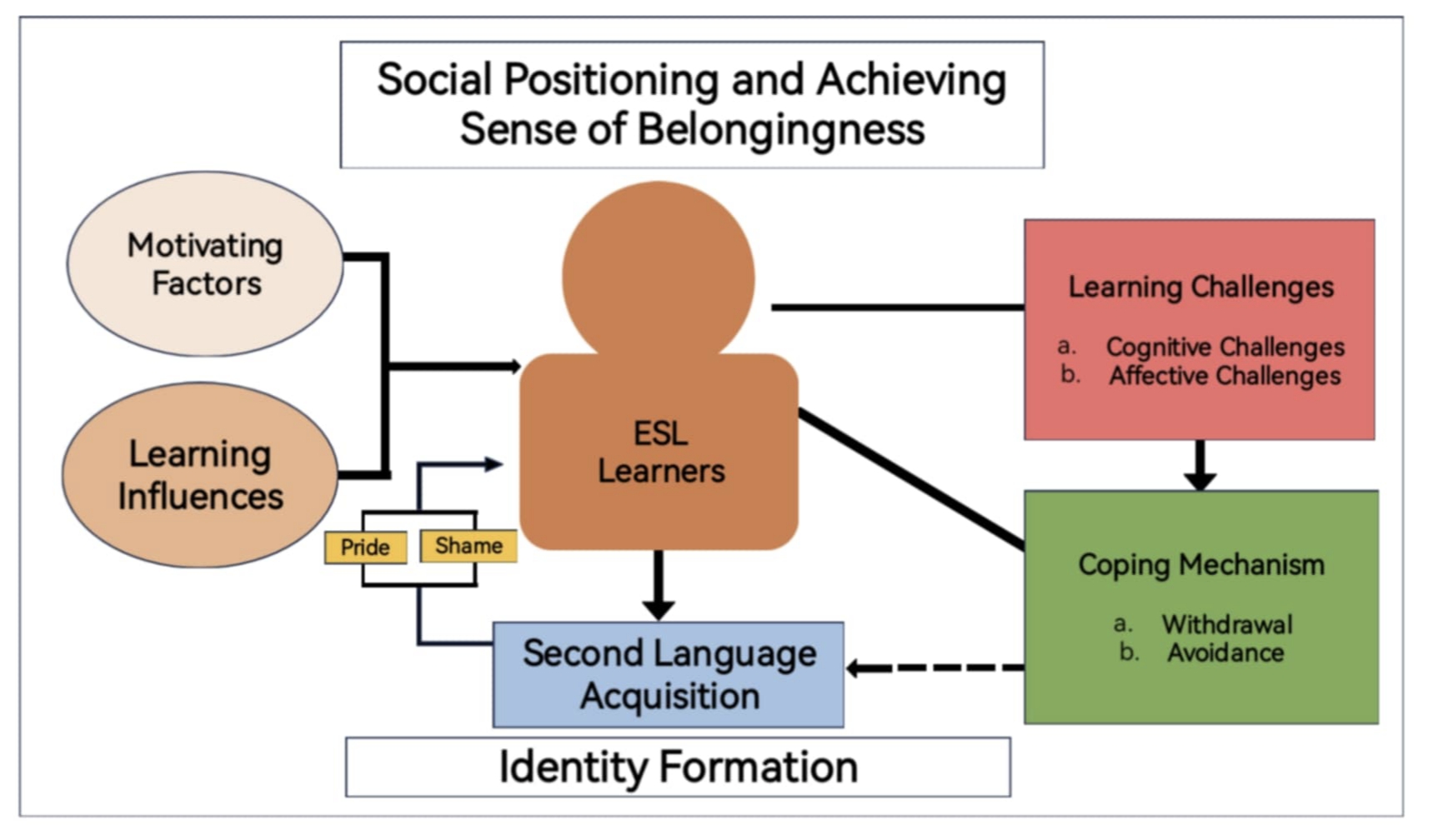
The research came up with the Conceptual Model of Identity Formation and Social Positioning to best represent the lived experiences of ESL learners in SLA. The model shows that there are motivating factors (Theme 1) and Learning Influences (Theme 2). These motivating factors may include encouragement in form of words, affirmative gestures, and praises and compliments received by learners from teachers and peers. Another motivation is the learners' own desire for learning fueled by the desire for validation and higher social standing. The influences, on the other hand, may come from media exposure, social influences, and role models. These make ESL learners more engaged in second language learning that could ultimately lead to the acquisition of the TL (represented by the line connecting ESL learners to language Second Language Acquisition). However, despite the motivations, the conceptual model shows that learners still experience challenges, both cognitive and affective (Theme 4) in forms of: struggle for accuracy; and, fear of judgement, suffering from self-doubt from comparison, and feeling of inadequacy, respectively. These challenges then lead ESL learners to withdraw or avoid communicative tasks bringing changes (represented by the broken lines connecting withdrawal and avoidance to Second Language Acquisition) to the actual learning process that may hinder the success of SLA. On the other hand, in times that L2 learners acquired the second language, this is considered as a success giving them the sense of pride (Theme 6). On the other hand, ESL acquisition may also bring learners shame as they are perceived negatively by others because of the negative stigma people hold against those who are fluent in ESL. Over-all, this process of acquiring the second language leads to the formation of identity (Theme 5) and social positioning achieving sense of belongingness (Theme 4 & Theme 5) allowing the learners to experience social validation necessary in placing themselves within a linguistic setting.
Conclusion and Recommendations
The first paragraph should be focused on the conclusions of the study. The conclusion should be written in a concise, clear paragraph that summarizes the main insights of the study without repeating detailed results. It must directly address the research objectives or questions and emphasize the study’s contributions, innovations, or improvements to existing knowledge, theory, or practice. The conclusion should synthesize the findings, demonstrating their significance and relevance to the field, while avoiding restating the abstract or experimental data.
The second paragraphs should be allotted for recommendations. Recommendations should form a separate paragraph that provides actionable guidance based on the study’s results. For practice, suggest strategies or interventions that can be implemented to improve outcomes. For policy, indicate how findings can inform decision-making or regulatory frameworks. For future research, highlight gaps or unresolved questions and propose areas for further study. Recommendations should be specific, feasible, and aligned with the conclusions, ensuring practical and scientific relevance. This section must be limited to 2 paragraphs only.
This study explored the lived experiences of ESL learners in their journey in second language acquisition and understand how they make sense of said experiences in respect to factors that influenced them, the challenges they encountered, the emotions they navigate, the language exposure they engage in, and the ways these shape their evolving cultural, social, and academic identities. The study was found different motivating factors in ESL learning. This includes learners’ exposure to affective motivators such as encouragement in form of reassurance, praises, and complements; and, ego reflected on their sense of pride, desire for validation and recognition, and desire for higher social standing. They were also influenced by external motivators such as their exposure to media acting as their language tutor providing motivation, opportunity for adaptation, and taking the role of mentor and companion. Social influences also affect ESL learners desire to acquire the language. Teachers, skilled peers, parents, their social connection providing opportunity to practice, positive social environment, and their family's recognition of potentials and opportunities brought by the language are also seen as motivation. One driving force of ESL learners in acquiring English is their acknowledgment of the language as bridge to connection and identity. They see the language as tool for social interconnectedness, cultural understanding, and language unifier allowing them to forge connection with the world. ESL learners also see the power of language in shaping identity. The language allows them to craft identity towards belongingness and social positioning. It also acts as means of social navigation allowing them to build relationship. However, despite the motivation and benefits the learners experience, they also face challenges and insecurities in language learning; mostly affective and cognitive. Participants share experiences with public speaking jitters, inhibition to perform and participate caused by negative reception of the English language, fear of being corrected and evaluated, and loss of confidence and self-esteem. Learners also suffers from comparison and self-doubt leading to poor self-image rooted from insecurities, crushed confidence, and negative affective response from being over shadowed. Their feeling of inadequacy leads to communication avoidance and withdrawal mostly influenced by low self-esteem, fear of judgement, and frustration. Aside from affective challenges, learners also struggle cognitively from limitation with accuracy such as pronunciation, punctuation and spelling. ESL learners also experience the complex interplay of language and identity highlighting the influence of the language in: self-presentation by projecting intelligence, dependable-self, and social identity. Language is also said to have a transformative power developing sense of belongingness, enhancing confidence, and creating interpersonal and intrapersonal understanding. The language also allows learners to negotiate identity by the maximization of bilingual identity, creation of linguistic identities and personas, and celebration of bilingual identity and skills. However, the relationship between language and identity brings complexities. This is illustrated by the learners’ formation of identity leaning more on barrowed language, uncertainty in understanding own linguistic identity, and questioning sense of belongingness in bilingual setting. Participants also see pride as having both positive and negative hold to their acquisition of the language. They shared experiences where the feeling of linguistic superiority leads to being prideful but the same pride hey hold towards the success of their ESL acquisition also leads to disappointments when experiences language mishaps. This also cause the diminished sense of self-esteem rooting from the awareness of comparative ability. ESL acquisition also serve as source of validation. This commonly comes in form of intellectual validation from linguistic skills; command and presence achieved through the use of English; feeling of belongingness brought by ESL proficiency; and, fulfillment through peer precognition of competence. The findings of the study lead to the development of the Conceptual Model on Identity Formation and Social Positioning in ESL Learning, a model that represents the variables and elements involved in SLA and how the actual SLA process lead to identity formation and achieving belongingness and desired social position.
The findings of the study led to recommendations addressed to significant stakeholders in the language learning process. For language teachers, it was recommended that they come up with teaching strategies that will allow ESL learners to learn the language without much exposure to the possibility of peer evaluation as it triggers anxiety to them. Evaluation should be given in the absence of other learners giving them the sense of privacy. Language teachers should also recognize their role as role models to ESL learners and pay attention on how they carry themselves during conversations and tasks in the language as the study found out that ESL learners usually look up to their language teachers as motivation and role model. On the other hand, ESL learners must reflect on the ability of the language to build and break them focusing on how they should handle such effects as it was found out that language learning can be a source of pride or anxiety depending on whether it was a success or a failure. By doing so, they can be more in touch with their linguistic self, making language learning more comfortable and worthwhile. Appreciating the language's ability to connect them to the world can also act as motivation to acquire the language better as the study found out that language is seen as social and economic asset for future life and career. Curriculum planners, however, are advised to maximize and incorporate the presence of authentic language contents from media in designing learning curriculum and lessons. Seeing how ESL learning is influenced by various social relationship, curriculum should be planned in a way that it encourages more authentic encounters with the language considering the presence of possible social influences. It should focus on helping students master the TL for better career-planning and opportunity-taking as the result of the research pointed out that learners and the people around them see the acquisition of the English language as investment and capital for future endeavors. Most importantly, future researchers are encouraged to explore the validity and reliability of the developed Conceptual Model on Identity Formation and Social Positioning in ESL Learning. Quantitative studies can be performed to provide statistical insights on the accuracy of said model. They may also come up with teaching-learning material based on the proposed model then test its effectiveness and acceptability through experimental and descriptive researches.
References
- Abdusyukur, M. R. (2022). The construction of Indonesian EFL learners’ identities: A narrativebased case study. LLT Journal: A Journal on Language and Language Teaching, 25(1), 227–239. DOI ↗ Google Scholar ↗
- Alimorad, Z., & Adib, F. (2022). The effects of pronunciation anxiety and motivation on English learners’ willingness to communicate. Gist Education and Learning Research Journal, 25, 41–62. DOI ↗ Google Scholar ↗
- Allami, H., Najari, B., & Tajeddin, Z. (2025). The impact of sociocultural theory-informed instruction on learners’ IELTS writing: Task response, grammar, vocabulary, coherence and cohesion. Asian-Pacific Journal of Second and Foreign Language Education, 10, Article 7. DOI ↗ Google Scholar ↗
- Ameen, S. T., & Najeeb, D. D. (2023). Overcoming hurdles in English language acquisition: Exploring themes and remedies for speaking challenges among basic school students in Duhok City. Russian Law Journal, 11(5), 910–922. DOI ↗ Google Scholar ↗
- Aporbo, R. (2024). Language anxiety of ESL learners: A phenomenological inquiry. Canadian Journal of Language and Literature Studies, 4(1), 40–59. DOI ↗ Google Scholar ↗
- Aron-Salvacion, J. (2023). Perception in implementing English as a medium of instruction: A phenomenological study in upper secondary levels S.Y. 2022–2023. Journal of Languages, Linguistics and Literary Studies, 3(2), 72–85. DOI ↗ Google Scholar ↗
- Bao, Y., & Liu, S. (2021). The influence of affective factors in second language acquisition on foreign language teaching. Open Journal of Social Sciences, 9, 463–470. DOI ↗ Google Scholar ↗
- Cai, F., Fei, X., & Song, Q. (2023). Japanese-as-a-foreign-language acquisition affects native Chinese lexical processing among Chinese learners. Frontiers in Psychology, 14, 1142411. DOI ↗ Google Scholar ↗
- Cailao, C. G. L., & Diva, C. B. (2024). A phenomenological study of college ESL speakers’ experiences in acquiring English as a second language. International Journal of Scientific and Management Research, 7(7). DOI ↗ Google Scholar ↗
- Dewi, N. R., Rahman, R., & Farah, R. (2025). Comparing the effectiveness of two approaches in learning English in Indonesia. Lingeduca: Journal of Language and Education Studies, 4(1), 24–31. DOI ↗ Google Scholar ↗
- Dilnoza, A. (2023). Challenges in speaking and language acquisition: A case study. European Journal of Education and Applied Psychology, 1, 23–29. DOI ↗ Google Scholar ↗
- Fomenko, T., Bilotserkovets, M., Sbruieva, A., Kovalenko, A., & Bagatska, O. (2021). Social media projects for boosting intercultural communication by means of learning English. Amazonia Investiga, 10(48), 89–96. DOI ↗ Google Scholar ↗
- Gallagher, S. (2022). What is phenomenology? In Phenomenology (pp. 1–10). Cham: Springer International Publishing. DOI ↗ Google Scholar ↗
- Gapasin, R. B. (2024). Factors influencing learners’ motivation in learning English as a second language. Humanities and Social Sciences Department, St. John Berchmans High School, Philippines. DOI ↗ Google Scholar ↗
- Higgins, J. (2024). Virtual bridges to global competence: Cultivating undergraduates’ English communication and intercultural skills through online exchange. Journal of International Students, 14(4), 862–882. DOI ↗ Google Scholar ↗
- Hoque, E. (2017). An introduction to the second language acquisition. Language Acquisition, 1–23. DOI ↗ Google Scholar ↗
- Khajavy, G. H., & Lüftenegger, M. (2024). Pride in foreign language learning: A conceptual framework and empirical evidence. Innovation in Language Learning and Teaching. DOI ↗ Google Scholar ↗
- Kiran, U., & Baig, I. A. (2021). Effectiveness of grammar translation method and communicative language teaching approach on students’ achievement in English grammar. Pakistan Social Sciences Review, 5(III), 235–248. DOI ↗ Google Scholar ↗
- Lee, J., Son, M., & Lee, J. (2024). An alternative method of assessing d/DHH secondary-school students’ L2 language development. American Annals of the Deaf, 168(5), 258–273. DOI ↗ Google Scholar ↗
- Leis, A. (2021). Praise in the EFL classroom: A growth mindset perspective. Theory and Practice of Second Language Acquisition, 7(2), 37–59. DOI ↗ Google Scholar ↗
- Lindberg, R., McDonough, K., & Trofimovich, P. (2022). Second language anxiety in conversation and its relationship with speakers’ perceptions of interaction and social networks. Studies in Second Language Acquisition, 45(5), 1413–1426. DOI ↗ Google Scholar ↗
- Manalastas, N. E. L. (2022, August). The good and the bad: The social role and position of English in the Philippines. UP Working Papers in Linguistics, 1(1). University of the Philippines System. DOI ↗ Google Scholar ↗
- Nasir, M., Ahmad, J., Arshad, N., Hasnain, H., & Ali, A. (2023, November 11). Effects of cultural and linguistic diversity on ESL learner’s speaking skills: A sociolinguistics study. Al-Qanṭara, Revista de Estudios Árabes, 10(2), 365. DOI ↗ Google Scholar ↗
- Nikmah, A., & Dzulfahmi, D. (2020). The effects of using movies in improving vocabulary and motivation to learn. Journal of English Language Teaching, 9(2), 347–356. DOI ↗ Google Scholar ↗
- Nurilahi, R., & Suhartono, L. (2022). An analysis on the cause of students’ speaking anxiety in EFL classroom. Journal of English Education Program, 3(2), 95–104. DOI ↗ Google Scholar ↗
- Ozaki, S. (2022, January–February). The impact of English on the economic development of the Philippines. South Asian Research Journal of Arts, Language and Literature, 4(1), 20–25. DOI ↗ Google Scholar ↗
- Paradowski, M. B., Jarynowski, A., Czopek, K., & Jelińska, M. (2021). Peer interactions and second language learning: The contributions of social network analysis in study abroad versus athome environments. In Language, Mobility and Study Abroad in the Contemporary European Context (pp. 153–170). Routledge. DOI ↗ Google Scholar ↗
- Peng, C. (2021). The academic motivation and engagement of students in English as a foreign language classes: Does teacher praise matter? Frontiers in Psychology, 12, Article 778174. DOI ↗ Google Scholar ↗
- Qiao, C. (2024). Factors influencing second language learning based on the research of Lightbown and Spada. Frontiers in Psychology, 15, 1347691. DOI ↗ Google Scholar ↗
- Rahmat, N. H., Abu Bakar, A. M., Zamri, A. H., Roslan, A. N., Zakaria, A. Z., Sabandi, D. T. A., & Zaki, M. A. I. M. (2021). A study of speech anxiety among ESL learners. European Journal of English Language Teaching, 6(4), 1–15. DOI ↗ Google Scholar ↗
- Roslim, N., Abd Rahman, S., & Ishak, N. H. (2021). Exploring movies for language teaching and learning at the tertiary level. Asian Journal of University Education, 17(3), 260–270. DOI ↗ Google Scholar ↗
- Salameh, M. Y. A. B. (2022). Speaking anxiety: A study of Jordanian EFL learners. Linguistics and Culture Review, 6(S2), 693–707. DOI ↗ Google Scholar ↗
- Solhi, M. (2024). Do L2 teacher support and peer support predict L2 speaking motivation in online classes? The AsiaPacific Education Researcher, 33, 829–842. DOI ↗ Google Scholar ↗
- Tuncel, F., Yapıcı, A., Akman, P., Elçi, A. C., Demiroğları, B., & Kutlu, M. O. (2020). Foreign language anxiety of adolescent students. African Educational Research Journal, 8(Special Issue 2), S164–S169. DOI ↗ Google Scholar ↗
- Umar, K. (2024). The use of ESL textbooks and students’ performance in speaking: A case study of some secondary schools in Ringim LGA, Jigawa State. British Journal of Multidisciplinary and Advanced Studies, 5(4). DOI ↗ Google Scholar ↗
- Van Manen, M. (1977). Linking ways of knowing with ways of being practical. Curriculum Inquiry, 6(3), 205–228. DOI ↗ Google Scholar ↗
- Van Manen, M. (2023). Phenomenology of practice: Meaning-giving methods in phenomenological research and writing. Routledge. DOI ↗ Google Scholar ↗
- Wang, Y. (2021). Authenticity of identity and second language learning. SAGE Open, 11(4), 1–8. DOI ↗ Google Scholar ↗
- Wolf, D. M., & Phung, L. (2019). Language learning challenges, strategies, and support: International students' perspectives. Journal of International Students, 9(1), 211–224. DOI ↗ Google Scholar ↗
- Wu, M., & Cai, J. (2025). The impact of teachers’ caring behavior on EFL learners’ academic engagement: The chain mediating role of selfefficacy and peer support. BMC Psychology, 13, Article 728. DOI ↗ Google Scholar ↗
- Wu, X., Yang, H., Liu, J., & Liu, Z. (2022, October 19). English use anxiety, motivation, self-efficacy, and their predictive effects on Chinese top university students’ English achievements. Frontiers in Psychology, 13. DOI ↗ Google Scholar ↗