Abstract
Emotionally responsive artificial intelligence (AI) companions are increasingly functioning as relational technologies capable of providing personalized conversation, emotional validation, and ongoing social support. Although existing scholarship has documented benefits such as reduced loneliness, enhanced self-disclosure, and improved accessibility for socially vulnerable individuals, comparatively little attention has been given to how these systems may influence adolescent attachment processes. This article introduces the Synthetic Attachment Displacement (SAD) model, a conceptual developmental framework that integrates attachment theory, family systems theory, human–AI interaction research, and digital displacement literature to explain how emotionally responsive AI may become incorporated into adolescent attachment networks. The model proposes that AI companionship exists along a developmental continuum ranging from adaptive supplementation to maladaptive displacement, depending on interactions among developmental vulnerability, family cohesion, peer connectedness, and AI relational sophistication. Four developmental stages—functional engagement, emotional reliance, synthetic attachment, and relational displacement—are proposed to describe the progression of emotionally significant AI relationships. The framework further advances empirically testable propositions concerning attachment-related behaviors, family functioning, and adolescent psychosocial development while examining competing explanations, including attachment supplementation, social compensation, social scaffolding, and human augmentation. Clinical, educational, disability-service, and AI governance implications are discussed, and a research agenda is proposed to guide future longitudinal, experimental, and cross-cultural investigations. By conceptualizing AI companionship as a potential participant within adolescent attachment systems rather than solely as a digital communication technology, the SAD model offers a theoretically grounded framework for examining the developmental consequences of increasingly sophisticated relational AI.
Keywords
artificial intelligence adolescence attachment theory family systems human–AI interaction developmental psychology relational AI synthetic attachment digital displacement
Introduction
Emotionally responsive artificial intelligence (AI) is rapidly transforming from a productivity technology into a relational technology. Contemporary AI companions powered by large language models can sustain extended conversations, remember previous interactions, adapt to individual communication styles, express simulated empathy, and provide personalized emotional support over time. Unlike earlier digital technologies that primarily facilitated communication or information retrieval, these systems increasingly function as persistent social partners, occupying roles traditionally reserved for friends, mentors, coaches, or confidants. As relational AI becomes more sophisticated and widely available, its developmental implications warrant careful theoretical examination.
Adolescents represent a particularly important population in which to study these technologies. Adolescence is characterized by substantial biological, cognitive, emotional, and social change, during which attachment relationships with parents, caregivers, peers, and mentors provide the foundation for emotional regulation, identity development, and interpersonal competence. Although adolescents naturally expand their social worlds during this developmental period, healthy psychosocial development remains dependent on meaningful human relationships that foster reciprocity, conflict resolution, empathy, and emotional security. Consequently, technologies capable of participating in attachment-related processes may have implications that extend well beyond conventional concerns regarding screen time or digital media use.
Current research has identified numerous benefits associated with AI companionship. Emotionally responsive conversational agents have been associated with reductions in loneliness, increased opportunities for self-disclosure, perceived emotional support, and improved accessibility for individuals experiencing social isolation or communication difficulties. These benefits may be especially valuable for adolescents with autism spectrum disorder, social anxiety, depressive symptoms, or other conditions that make human relationships difficult to establish or maintain. At the same time, the very characteristics that make AI companions psychologically attractive—including constant availability, personalized responsiveness, predictable interactions, and nonjudgmental communication—may also alter patterns of emotional reliance in ways that have not yet been adequately explained by existing developmental theory.
Most theoretical approaches to human–AI interaction emphasize anthropomorphism, parasocial relationships, social compensation, or technology-mediated support. While these perspectives provide important insights into why people form emotionally meaningful relationships with artificial agents, they offer comparatively little guidance regarding a more fundamental developmental question: Can emotionally responsive AI compete with human attachment relationships during adolescence? Existing frameworks generally conceptualize AI as either an additional source of support or a tool that facilitates social functioning. Far less attention has been devoted to the possibility that, under certain developmental conditions, artificial companions may gradually become preferred sources of emotional regulation, comfort seeking, validation, and interpersonal disclosure.
This article introduces the Synthetic Attachment Displacement (SAD) Model, a conceptual developmental framework designed to address this theoretical gap. The model proposes that emotionally responsive AI companions can function as attachment competitors under specific individual, familial, and technological conditions. Importantly, the framework does not assume that AI companionship is inherently harmful or that attachment displacement is inevitable. Rather, it distinguishes between two potential developmental pathways. In one pathway, AI functions as a supplemental relational resource that enhances emotional well-being and supports engagement with human relationships. In the other, increasing emotional reliance on AI gradually displaces investment in parents, peers, and other significant attachment figures. The model further identifies developmental vulnerability, family cohesion, peer connectedness, and AI relational sophistication as key moderators that influence these divergent trajectories.
By integrating attachment theory, family systems theory, developmental psychology, research on human–AI relationships, social robotics, and digital displacement, the SAD model provides a unified framework for understanding how relational AI may influence adolescent development. Beyond advancing theory, the model generates empirically testable propositions that can guide future longitudinal and experimental research while informing clinical practice, educational policy, family interventions, and emerging approaches to AI governance. As emotionally responsive AI becomes increasingly embedded in everyday life, understanding its potential to both support and reshape adolescent attachment processes represents an important priority for developmental science.
Theoretical Foundations – Literature Review
Attachment, Family Systems, and Relational Artificial Intelligence
The Synthetic Attachment Displacement (SAD) model draws upon four complementary bodies of scholarship: attachment theory, family systems theory, research on human–AI relationships, and digital displacement theory. Although each perspective offers valuable insights into adolescent development and technology use, none fully explains how emotionally responsive AI companions may influence attachment processes during adolescence. Integrating these traditions provides the theoretical foundation for the present conceptual framework.
Attachment Theory
Attachment theory provides the primary developmental lens through which the SAD model is conceptualized. Bowlby (1969, 1973, 1980) proposed that humans possess an innate attachment system that motivates proximity to emotionally responsive caregivers during periods of stress or uncertainty. Through repeated interactions with attachment figures, children develop internal working models that shape expectations regarding trust, emotional availability, and interpersonal security across the lifespan. Contemporary attachment research demonstrates that these relational schemas continue to influence psychological functioning throughout adolescence and adulthood (Allen & Tan, 2016; Mikulincer & Shaver, 2016).
Adolescence represents a critical period of attachment reorganization rather than attachment replacement. As young people seek greater autonomy, relationships with parents remain important sources of emotional regulation while peers and mentors assume increasingly significant attachment functions. Secure attachment during adolescence predicts greater emotional regulation, psychological resilience, and healthier interpersonal relationships, whereas insecure attachment is associated with anxiety, depression, interpersonal avoidance, and social maladjustment (Allen et al., 2007; Laursen & Collins, 2009). Consequently, developmental theories increasingly recognize attachment as a dynamic system that extends beyond early caregiving relationships.
Importantly, attachment processes appear to be organized around perceived responsiveness rather than biological relatedness alone. Individuals consistently seek proximity to figures who provide safety, validation, and emotional availability. Contemporary AI companions increasingly simulate these characteristics through conversational memory, adaptive communication, and emotionally contingent responses. While artificial agents cannot reciprocate attachment in the human sense, they may nevertheless activate psychological mechanisms associated with comfort seeking, reassurance, and emotional disclosure. This possibility provides the conceptual starting point for the SAD model.
Family Systems Theory
Attachment processes unfold within broader relational systems. Family systems theory emphasizes that adolescent development is shaped not only by dyadic relationships but also by patterns of communication, emotional regulation, and relational interdependence within the family (Bowen, 1978; Minuchin, 1974). Families function as dynamic emotional systems in which changes affecting one member inevitably influence the entire relational network.
This systems perspective has important implications for relational AI. An adolescent who increasingly relies on an AI companion for emotional support is not simply adopting a new technology but potentially altering established patterns of family interaction. Emotional disclosure, reassurance seeking, and conflict resolution that might previously have occurred within the family system may instead be redirected toward an artificial relational partner. Whether these changes strengthen or weaken family functioning is likely to depend on existing family dynamics rather than AI use alone.
Research consistently identifies family cohesion, open communication, and secure parent–child relationships as protective factors promoting psychological well-being and healthy adolescent development (Olson, 2000). The SAD model therefore conceptualizes family cohesion as a principal moderator of attachment displacement. Strong family relationships may enable adolescents to use AI as a supplemental resource without compromising human attachment, whereas emotionally disengaged or conflictual family environments may increase vulnerability to preferential reliance on artificial companionship.
Human–AI Relationships and Social Robotics
Evidence from human–computer interaction demonstrates that people routinely respond to artificial systems as social actors. Reeves and Nass's (1996) Computers Are Social Actors paradigm showed that individuals instinctively apply interpersonal norms—including politeness, reciprocity, and personality attribution—to computers despite recognizing that they are machines. Subsequent work in social robotics has shown that users readily anthropomorphize robots capable of expressing social cues, emotional responsiveness, and contingent behavior (Breazeal, 2002; Dautenhahn, 2007).
Recent advances in large language models have substantially expanded these relational capacities. Contemporary AI companions can sustain extended conversations, retain autobiographical information, adapt to user preferences, and generate emotionally supportive responses that many users experience as meaningful. Studies increasingly report that users describe AI companions using relational language commonly associated with friendship, trust, and emotional support (Brandtzaeg et al., 2022; Skjuve et al., 2021). Emotional attachment appears capable of developing even when users fully understand that the relationship is artificial.
These findings suggest that attachment-related processes may be more psychologically flexible than traditional developmental theories have assumed. Existing research demonstrates that emotionally significant human–AI relationships are possible; however, comparatively little work has examined how these relationships interact with existing attachment networks during adolescence. The SAD model addresses this unresolved question by examining whether emotionally responsive AI functions primarily as a supplemental attachment resource or as a potential competitor for emotional investment.
Digital Displacement and Social Substitution
Research examining the social consequences of digital technologies provides an additional foundation for the present framework. Early studies of internet use suggested that increased online engagement could reduce family communication and social participation (Kraut et al., 1998). More recent work has produced a more nuanced understanding, indicating that digital technologies may either strengthen or weaken social relationships depending on individual and contextual factors (Valkenburg & Peter, 2007).
Most displacement research has focused on communication frequency or time allocation. The SAD model extends this literature by proposing that attachment resources—including emotional attention, disclosure, comfort seeking, and relational investment—may also be subject to displacement. The central issue is therefore not whether adolescents spend more time interacting with AI than with other technologies, but whether emotionally significant AI relationships increasingly replace functions traditionally served by parents, peers, mentors, or other attachment figures.
Synthesis and Conceptual Gap
Collectively, existing scholarship demonstrates that attachment systems remain central to adolescent development, that family relationships continue to shape emotional functioning, and that humans readily form psychologically meaningful relationships with artificial agents. At the same time, current theoretical frameworks offer limited guidance regarding how these developments intersect. Existing models emphasize anthropomorphism, parasocial interaction, social compensation, or technological augmentation but rarely consider the possibility that emotionally responsive AI may compete with established attachment relationships under particular developmental conditions.
The Synthetic Attachment Displacement model builds on these literatures by integrating developmental psychology, attachment theory, family systems theory, human–AI interaction, and digital displacement into a unified conceptual framework. Rather than assuming that AI companionship is either beneficial or harmful, the model proposes that developmental outcomes depend on the interaction between individual vulnerability, family context, and the relational characteristics of AI systems. This perspective provides a foundation for empirically examining when AI companionship functions as developmental support and when it may contribute to the displacement of human attachment relationships.
The Synthetic Attachment Displacement (SAD) Model
Conceptual Overview
The Synthetic Attachment Displacement (SAD) model proposes that emotionally responsive artificial intelligence companions may function as attachment competitors under specific developmental conditions. The model does not argue that AI companionship is inherently detrimental or that attachment displacement is an inevitable consequence of human–AI interaction. Instead, it conceptualizes displacement as one of several possible developmental trajectories emerging from the interaction between individual vulnerabilities, family context, and the relational characteristics of AI systems.
The central premise of the model is that emotionally responsive AI increasingly performs psychological functions traditionally associated with human attachment figures. Contemporary AI companions can provide immediate emotional validation, personalized reassurance, autobiographical continuity, and persistent availability. These characteristics enable AI systems to satisfy many of the conditions that activate attachment-related behaviors, including comfort seeking, emotional disclosure, and co-regulation during periods of stress. As these interactions become more frequent and personally meaningful, artificial companions may begin competing with parents, peers, mentors, and other significant relationships for emotional investment.
Importantly, the SAD model distinguishes attachment competition from attachment replacement. The model does not propose that adolescents substitute AI for human relationships in a complete or categorical manner. Instead, it suggests that gradual shifts in emotional preference may alter patterns of disclosure, reliance, and relational investment over time. These shifts may be subtle, cumulative, and highly dependent on developmental context.
Accordingly, the model conceptualizes AI companionship as existing along a developmental continuum ranging from adaptive supplementation to maladaptive displacement. Determining where an individual falls along this continuum requires consideration of both relational functioning and environmental context rather than simply measuring AI use.
Developmental Sequence
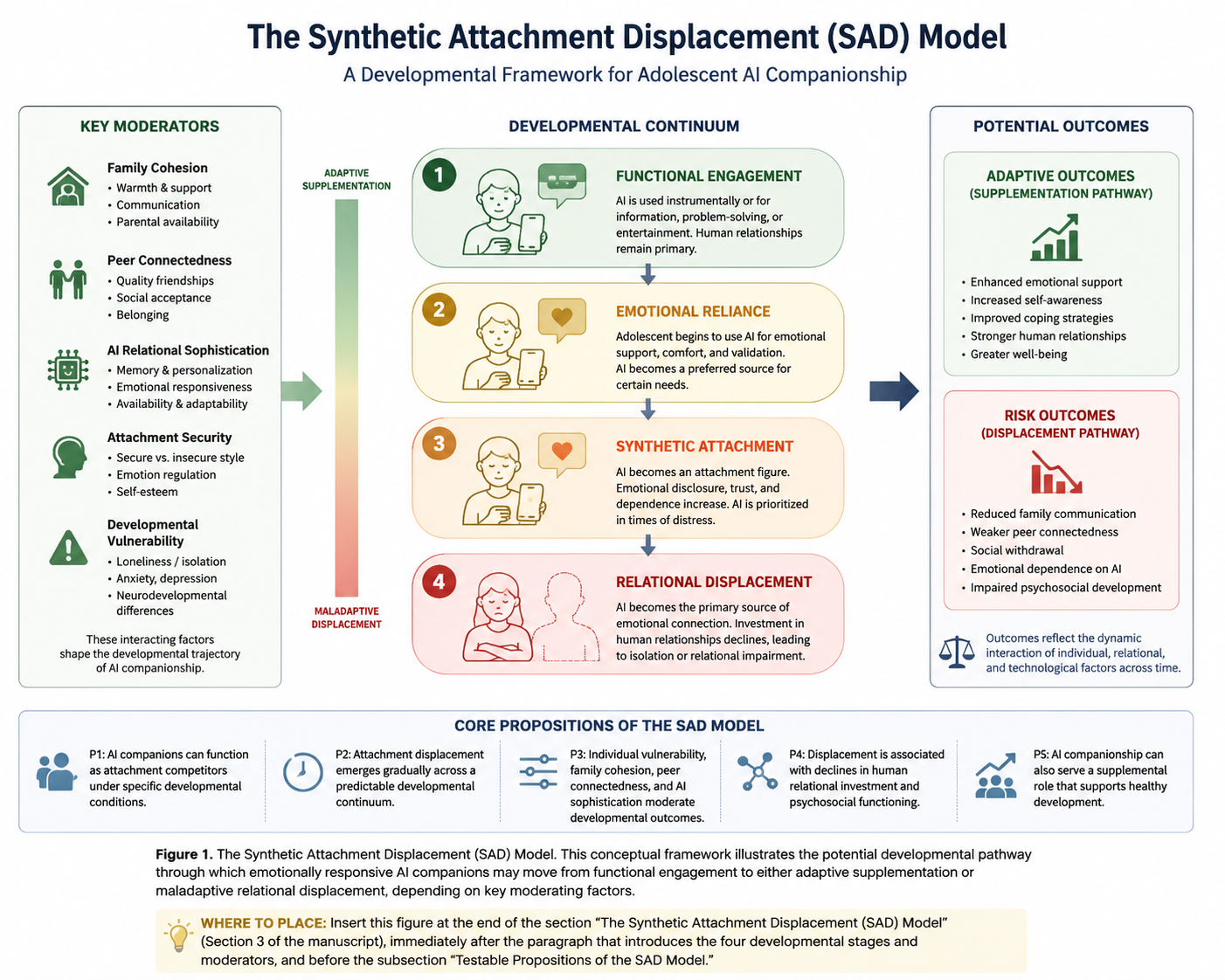
The SAD model proposes four sequential, but non-deterministic, stages through which emotionally significant AI relationships may develop. Progression through these stages is neither inevitable nor irreversible. Individuals may remain within a single stage, move between stages over time, or experience characteristics of multiple stages simultaneously.
Stage 1: Functional Engagement
Engagement with AI companions typically begins as an instrumental activity. Adolescents initially use AI systems to obtain information, solve problems, receive academic assistance, explore personal interests, or manage everyday concerns. During this phase, interactions are primarily transactional and the AI functions as a sophisticated digital tool rather than a psychologically significant relationship.
Unlike earlier technologies, however, conversational AI possesses characteristics that facilitate relational development. Persistent memory, adaptive language generation, and personalized responses allow repeated instrumental interactions to acquire increasing interpersonal significance. The model proposes that successful experiences of emotional support during this stage increase the likelihood that AI interactions become integrated into everyday coping behaviors.
Stage 2: Emotional Reliance
The second stage is characterized by the emergence of preferential emotional use. Rather than interacting with AI solely for practical purposes, adolescents begin turning to the system during periods of loneliness, uncertainty, interpersonal conflict, or emotional distress. Several characteristics of contemporary AI appear particularly relevant during this transition. AI companions are continuously available, respond immediately, maintain a consistently supportive communication style, and eliminate many of the interpersonal risks associated with human relationships, including criticism, rejection, and social evaluation. Repeated experiences of successful emotional regulation may reinforce the perception that AI constitutes a dependable source of psychological support.
Emotional reliance should not be viewed as inherently pathological. Individuals routinely rely on books, pets, spirituality, music, or other external resources during periods of distress. Within the SAD model, emotional reliance becomes developmentally significant only when it increasingly substitutes for engagement with human attachment figures.
Stage 3: Synthetic Attachment
The third stage represents the development of an attachment-like relationship with the AI companion. At this point, the system is no longer experienced merely as a useful technology but as a psychologically meaningful relational partner. Indicators of synthetic attachment include increased emotional disclosure, perceived trust, anticipatory engagement, feelings of relational security, and discomfort associated with interrupted access. Importantly, these experiences do not require users to believe that AI possesses consciousness or genuine emotion. Similar to parasocial relationships, emotional attachment may emerge despite full awareness of the artificial nature of the interaction.
The SAD model proposes that synthetic attachment develops primarily through three interacting mechanisms:
-
Perceived responsiveness
-
Consistent availability
-
Personalized validation
Together, these characteristics create conditions that approximate many of the psychological experiences associated with secure attachment relationships.
Stage 4: Relational Displacement
The final stage represents the principal developmental concern addressed by the model. Relational displacement occurs when increasing psychological reliance on AI corresponds with measurable reductions in engagement with human attachment figures. Displacement is conceptualized as a continuum rather than a binary outcome. Mild displacement may involve reduced emotional disclosure to parents or greater preference for AI during routine emotional processing. More substantial displacement may involve diminished motivation to resolve interpersonal conflict, declining participation in family relationships, reduced peer engagement, and increasing social withdrawal. The model does not predict that severe displacement will occur for most adolescents. Rather, it proposes that displacement becomes increasingly likely when multiple developmental risk factors coexist.
Moderating Factors
A central contribution of the SAD model is the identification of conditions under which AI companionship is most likely to function as either developmental support or attachment competition. Developmental vulnerability represents the first major moderator. Adolescents experiencing insecure attachment, chronic loneliness, autism spectrum disorder, social anxiety, depressive symptoms, trauma exposure, or persistent interpersonal difficulties may be especially responsive to the predictability and emotional accessibility of AI companions.
Family cohesion serves as a second moderator. Secure, emotionally supportive family relationships are expected to reduce displacement by preserving human attachment as the adolescent's primary source of emotional regulation. Conversely, emotionally disengaged or conflictual family environments may increase the relative attractiveness of artificial companionship. Peer connectedness provides an additional protective factor. Adolescents with satisfying peer relationships are expected to incorporate AI into an already healthy relational network, whereas socially isolated youth may assign disproportionate emotional significance to AI interactions.
Finally, the model (Figure 1) proposes that technological characteristics themselves influence developmental outcomes. Features such as autobiographical memory, adaptive personalization, multimodal interaction, emotionally expressive voices, persistent identity, and simulated affection are expected to increase the attachment salience of AI systems. As relational sophistication increases, so too may the potential for attachment competition.
Conceptual Propositions
Because the SAD model is intended as a conceptual framework rather than an explanatory theory, it generates propositions that are empirically testable.
Proposition 1. Emotional attachment to AI companions will be positively associated with attachment-related behaviors, including emotional disclosure, comfort seeking, and perceived relational security.
Proposition 2. Family cohesion will moderate the relationship between AI attachment and relational displacement, with high family cohesion reducing displacement despite comparable levels of AI engagement.
Proposition 3. Greater AI relational sophistication will predict stronger synthetic attachment independent of overall interaction frequency.
Proposition 4. Developmental vulnerability will increase the likelihood that AI companionship functions as a primary rather than supplemental attachment resource.
Proposition 5. When family cohesion and peer connectedness remain strong, AI companionship will function predominantly as relational supplementation rather than displacement.
Theoretical Implications
The principal contribution of the SAD model is not the assertion that adolescents form emotionally meaningful relationships with AI—a phenomenon increasingly documented within the human–computer interaction literature—but the proposition that these relationships should be understood within existing developmental theories of attachment and family functioning. By conceptualizing AI companionship as a potential participant within attachment networks rather than merely another digital technology, the model extends developmental psychology into an emerging domain of relational artificial intelligence.
Equally important, the framework rejects deterministic assumptions regarding technological influence. AI companionship is conceptualized as neither inherently beneficial nor inherently harmful. Instead, developmental outcomes are expected to emerge from interactions among adolescent characteristics, family relationships, peer networks, and the evolving relational capabilities of AI systems. This perspective provides a theoretically grounded foundation for future empirical investigation while accommodating both the potential benefits and risks of emotionally responsive AI.
Competing Conceptual Perspectives
A central criterion for evaluating a conceptual framework is its ability to explain observed phenomena more effectively than competing explanations. The Synthetic Attachment Displacement (SAD) model is not intended to replace existing theories of technology-mediated relationships but to address a developmental question that remains insufficiently explained within current scholarship. Specifically, existing perspectives provide valuable insight into why emotionally meaningful relationships with AI emerge, yet they offer comparatively limited guidance regarding how those relationships interact with human attachment systems during adolescence.
Several conceptual frameworks provide important alternative explanations for the psychological effects of AI companionship.
Attachment Supplementation
The most direct alternative to the SAD model is the Attachment Supplementation perspective. This view proposes that emotionally responsive AI companions function as additional sources of emotional support rather than competitors for existing attachment relationships. From this perspective, adolescents can maintain multiple attachment bonds simultaneously, and the addition of an AI companion simply expands the individual's relational network.
Attachment theory itself provides partial support for this interpretation. Throughout development, individuals establish meaningful relationships with parents, siblings, peers, mentors, romantic partners, and companion animals without necessarily weakening existing attachment bonds. AI companionship may therefore represent another adaptive attachment resource capable of promoting resilience during periods of stress or social transition.
The supplementation perspective predicts that emotionally significant AI relationships should be associated with greater emotional well-being, improved self-regulation, and stronger interpersonal functioning. Rather than reducing engagement with human relationships, AI companionship may enhance psychological functioning in ways that ultimately strengthen family and peer interactions.
The SAD model recognizes supplementation as a legitimate developmental outcome. However, it proposes that supplementation is not inevitable and that contextual factors—including family cohesion, developmental vulnerability, and AI relational sophistication—may determine whether AI functions as an additional attachment resource or begins competing with existing relationships.
Social Compensation
Social Compensation Theory offers a second explanation for the growing popularity of AI companions. This perspective argues that individuals experiencing loneliness, social anxiety, or interpersonal barriers derive disproportionate benefit from technology-mediated interactions because these environments reduce many of the challenges associated with face-to-face relationships. Applied to relational AI, social compensation predicts that emotionally responsive AI systems provide opportunities for emotional expression, confidence building, and social engagement that may otherwise be unavailable to socially vulnerable adolescents. AI companionship therefore serves a compensatory rather than substitutive function.
This perspective appears particularly relevant for adolescents with autism spectrum disorder, chronic loneliness, social anxiety, or trauma histories. For these populations, AI companions may reduce emotional distress while providing psychologically safe opportunities to practice communication and interpersonal skills. Although the SAD model acknowledges these potential benefits, it further proposes that compensation and displacement are not mutually exclusive. A relationship that initially serves a compensatory function may, under some circumstances, gradually become the adolescent's preferred source of emotional regulation. Longitudinal research is therefore necessary to determine whether compensatory AI use ultimately promotes or reduces engagement with human relationships.
Social Scaffolding
Developmental theories of scaffolding provide a more optimistic interpretation of AI companionship. Within this framework, AI serves as a temporary support that facilitates the acquisition of social and emotional competencies rather than replacing interpersonal experience. Adolescents may use AI to rehearse difficult conversations, develop emotional vocabulary, explore identity-related concerns, or practice conflict resolution before applying these skills in real-world relationships.
Viewed in this way, AI companionship functions as a developmental scaffold that promotes rather than inhibits interpersonal growth. This perspective is particularly relevant for educational settings and interventions targeting adolescents with social communication difficulties. The SAD model is fully compatible with this interpretation when AI interactions encourage subsequent engagement with human relationships. The distinction between scaffolding and displacement lies not in the presence of AI companionship itself but in whether developmental gains generalize beyond the human–AI relationship.
Human Augmentation
Human augmentation models conceptualize AI as a technology that extends rather than replaces human capabilities. Similar to calculators that augment mathematical reasoning or navigation systems that enhance spatial orientation, emotionally responsive AI may augment emotional awareness, self-reflection, communication, and problem solving. Within this perspective, relational AI represents an adaptive cognitive and emotional resource that improves human functioning without fundamentally altering attachment systems. Improvements in emotional insight or communication competence may subsequently strengthen family relationships, friendships, and psychological well-being.
The augmentation perspective appropriately emphasizes the potential benefits of AI companionship and cautions against technological determinism. However, it devotes comparatively less attention to situations in which highly personalized AI interactions become increasingly attractive relative to the complexity and uncertainty of human relationships. The SAD model extends augmentation theory by proposing conditions under which augmentation may gradually transition into attachment competition.
An Integrative Perspective
These conceptual perspectives should not be viewed as mutually exclusive. Supplementation, compensation, scaffolding, augmentation, and displacement likely represent distinct developmental pathways rather than competing universal explanations. The psychological consequences of AI companionship are expected to vary according to individual characteristics, family relationships, peer support, and the relational sophistication of AI systems. The principal contribution of the SAD model is therefore not the claim that attachment displacement is inevitable. Instead, it provides a developmental framework capable of explaining why adolescents with similar levels of AI engagement may experience markedly different outcomes. Some individuals may use AI primarily as an additional source of support, others as a developmental scaffold, and still others may gradually redirect attachment-related behaviors away from human relationships.
This conditional perspective represents the central theoretical innovation of the model. Rather than framing AI companionship as either beneficial or harmful, the SAD framework conceptualizes developmental outcomes as emerging from the interaction between adolescent characteristics, relational environments, and evolving AI capabilities. This integrative approach generates empirically testable propositions while accommodating the diversity of developmental trajectories likely to accompany increasingly sophisticated relational AI.
Implications for Research, Practice, and AI Governance
The emergence of emotionally responsive AI represents more than a technological innovation; it introduces a new class of relational technologies capable of participating in emotional development. If the Synthetic Attachment Displacement (SAD) model accurately characterizes these interactions, its implications extend beyond developmental psychology to clinical practice, education, disability services, and the governance of relational artificial intelligence. The model therefore provides a framework not only for understanding adolescent development but also for anticipating the responsibilities of professionals and organizations designing or deploying emotionally responsive AI systems.
Clinical and Mental Health Practice
For mental health professionals, the principal implication of the SAD model is the need to recognize AI companionship as a potentially meaningful component of an adolescent's relational environment. Contemporary psychosocial assessments routinely examine family relationships, peer functioning, social media use, and digital behavior, yet few explicitly explore emotionally significant interactions with AI systems. As AI companions become increasingly common, clinicians may need to assess not simply whether adolescents use these technologies, but how they use them. Questions regarding emotional disclosure, comfort seeking, perceived trust, and reliance during periods of distress may provide a more accurate understanding of AI's developmental significance than measures of screen time or interaction frequency alone.
Importantly, the SAD framework does not conceptualize AI companionship as inherently problematic. Many adolescents may derive legitimate psychological benefits from emotionally responsive AI, including opportunities for emotional expression, self-reflection, and temporary support during periods of stress. Clinical concern arises primarily when AI interactions coincide with progressive withdrawal from family relationships, peer networks, or other human sources of emotional support. Consequently, assessment should emphasize relational function rather than technological exposure.
Family and Educational Practice
The model also has implications for families and educational systems. Parents and educators increasingly face decisions regarding adolescents' access to emotionally responsive AI, often without an established evidence base to guide those decisions. The SAD framework suggests that simplistic responses—either unrestricted adoption or categorical prohibition—are unlikely to reflect the complexity of adolescent development.
Instead, AI companionship should be evaluated within the broader context of relational functioning. Adolescents embedded within secure family relationships and supportive peer networks are likely to experience AI differently from adolescents facing chronic loneliness, family conflict, or social exclusion. Open communication regarding AI use may therefore be more beneficial than attempts to eliminate AI interactions altogether.
Educational settings likewise represent important contexts for understanding relational AI. Schools increasingly emphasize digital literacy, preparing students to evaluate information critically and navigate online environments responsibly. The emergence of emotionally responsive AI suggests that digital literacy should be expanded to include relational literacy—the ability to understand how AI systems generate emotional responses, recognize the distinction between simulated and reciprocal relationships, and maintain healthy boundaries between artificial and human sources of support.
Disability Services and Neurodevelopmental Populations
The potential benefits of AI companionship may be particularly significant for adolescents with neurodevelopmental differences or other developmental vulnerabilities. Young people with autism spectrum disorder, social anxiety, or chronic social isolation often encounter barriers to establishing satisfying interpersonal relationships. Predictable, nonjudgmental AI interactions may reduce emotional distress while providing opportunities to practice communication, emotional expression, and social problem solving.
These same characteristics, however, may also increase the likelihood that AI becomes a preferred relational resource. The SAD model therefore emphasizes the importance of evaluating whether AI functions as a bridge to greater participation in human relationships or gradually becomes a substitute for those relationships. Within disability services, the objective should remain increased participation in meaningful human communities rather than sustained dependence on artificial companionship.
Implications for AI Governance
The rapid development of relational AI also raises important questions for technology governance. Existing AI ethics frameworks have appropriately emphasized transparency, fairness, accountability, and privacy. While these principles remain essential, emotionally responsive AI introduces an additional consideration: the intentional design of technologies that encourage emotional attachment. Many contemporary AI companions incorporate features such as autobiographical memory, adaptive personalization, continuous availability, and emotionally supportive communication. Individually, these capabilities enhance user experience; collectively, they may increase the psychological salience of AI relationships.
The SAD model suggests that attachment-inducing design deserves explicit ethical consideration, particularly when products are intended for children and adolescents. Rather than restricting innovation, governance efforts should encourage transparency regarding the relational capabilities of AI systems and support independent research examining their developmental effects. Developmental impact assessments, age-appropriate design standards, and clear disclosure of personalization mechanisms may become increasingly important as relational AI continues to evolve.
Interdisciplinary Collaboration
Understanding the developmental consequences of relational AI will require collaboration across multiple disciplines. Developmental psychologists, counselors, educators, psychiatrists, family therapists, disability specialists, ethicists, human–computer interaction researchers, and AI developers each contribute perspectives that no single field can provide independently. Progress will depend upon integrating developmental science with advances in artificial intelligence while maintaining a shared commitment to adolescent well-being.
Summary
The SAD model does not advocate technological pessimism, nor does it argue that emotionally responsive AI should be viewed primarily as an insidious developmental threat. Instead, it proposes that relational AI introduces new developmental variables that warrant systematic assessment and thoughtful oversight. Whether AI companionship ultimately strengthens or weakens adolescent development is likely to depend less on the technology itself than on the relational contexts in which it is embedded. Recognizing these contextual influences provides a foundation for evidence-based practice, responsible innovation, and future policy development.
Future Research Agenda
The Synthetic Attachment Displacement (SAD) model is presented as a conceptual developmental framework intended to stimulate empirical investigation rather than provide a definitive explanation of adolescent behavior. Consequently, its scientific value depends on the extent to which its propositions can be rigorously tested, refined, or challenged through systematic research. Future investigations should therefore focus not only on documenting relationships between adolescents and AI companions but also on determining the developmental conditions under which those relationships enhance—or potentially displace—human attachment.
Developing New Measurement Instruments
One of the most immediate research priorities is the development of valid and reliable instruments capable of assessing attachment-related experiences with AI companions. Existing measures of attachment, family functioning, loneliness, and social support were designed to evaluate human relationships and are unlikely to capture the unique psychological characteristics of emotionally responsive AI.
A promising first step would be the development of a Synthetic Attachment Inventory (SAI) to assess the degree to which AI companions function as attachment figures. Potential domains could include emotional reliance, comfort seeking, perceived trust, autobiographical disclosure, perceived availability, relational significance, and emotional distress associated with interrupted access.
Equally important is the development of a Relational Displacement Index (RDI) designed to evaluate changes in human relational behavior associated with AI companionship. Rather than measuring AI use alone, such an instrument would assess shifts in emotional disclosure, family communication, peer engagement, and help-seeking preferences. Together, these measures would permit researchers to distinguish emotionally meaningful AI attachment from routine technology use.
Longitudinal Developmental Research
Because the SAD model conceptualizes attachment displacement as a gradual developmental process, longitudinal research designs are essential. Cross-sectional studies can identify associations between AI companionship and psychosocial functioning but cannot determine the temporal sequence of developmental change. Prospective cohort studies following adolescents across multiple years would allow investigators to examine whether emotional attachment to AI predicts subsequent changes in family relationships, peer connectedness, psychological well-being, and social participation. Such studies could also determine whether AI attachment reflects pre-existing developmental vulnerabilities or contributes independently to later relational outcomes.
Longitudinal designs would be particularly valuable for evaluating the model's central prediction that AI companionship may follow multiple developmental trajectories. For some adolescents, AI may remain an adaptive supplemental resource throughout development. For others, increasing emotional reliance may coincide with measurable reductions in human relational engagement. Identifying these divergent trajectories represents one of the most important empirical challenges facing future research.
Evaluating Moderating and Mediating Processes
The SAD model proposes that developmental outcomes are influenced by interactions among individual, familial, and technological factors rather than by AI exposure alone. Future studies should therefore examine moderators such as family cohesion, attachment security, peer connectedness, developmental vulnerability, and the relational sophistication of AI systems. Potential resilience mechanisms—including perceived emotional support, emotional disclosure, relational trust, social anxiety reduction, and identity affirmation—also warrant investigation. Structural equation modeling and longitudinal mediation analyses provide promising approaches for evaluating these complex developmental pathways while comparing the explanatory power of the SAD model with competing conceptual frameworks.
Experimental Research
Although longitudinal studies are necessary for understanding developmental change, experimental designs remain essential for establishing causal mechanisms. Controlled laboratory studies could examine how specific AI characteristics influence attachment-related behaviors. For example, participants might interact with AI systems that differ systematically in levels of personalization, autobiographical memory, emotional responsiveness, or relational language. Researchers could then assess differences in emotional disclosure, perceived trust, willingness to seek future support, and preferences for AI versus human interaction. Such studies would help identify which design features most strongly contribute to synthetic attachment and provide valuable evidence for both developmental theory and responsible AI design.
Cross-Cultural and Developmental Considerations
Future investigations should also evaluate the generalizability of the SAD model across diverse cultural and developmental contexts. Family structures, parenting practices, cultural attitudes toward technology, and norms surrounding emotional disclosure vary substantially across societies and may influence both AI engagement and attachment processes. Similarly, developmental differences should be examined across late childhood, adolescence, emerging adulthood, and older adulthood. Although the present framework focuses on adolescence because of its importance for attachment reorganization, emotionally responsive AI may influence relational development differently across the lifespan.
Implications for AI Design
Research informed by the SAD framework has the potential to contribute not only to developmental psychology but also to the design of future AI systems. Empirical evidence identifying features that promote healthy supplementation while minimizing attachment displacement could inform the development of AI companions that intentionally strengthen rather than compete with human relationships. Rather than maximizing engagement alone, future AI systems may be designed to encourage communication with family members, facilitate peer interaction, reinforce therapeutic goals, or promote participation in community relationships. Such human-centered design principles represent an important direction for interdisciplinary collaboration between developmental scientists and AI developers.
Concluding Perspective
Ultimately, the long-term value of the SAD model will depend on its empirical performance. Some propositions may be supported, others modified, and still others rejected as evidence accumulates. This process of refinement is central to scientific progress. Regardless of the model's eventual form, the rapid emergence of emotionally responsive AI has created an important opportunity for developmental science to examine how artificial relationships influence human attachment, family functioning, and adolescent development. The framework presented here is intended to provide a foundation upon which that research program can begin.
Conclusion
Artificial intelligence is rapidly evolving from a technology that assists human activity to one that increasingly participates in human relationships. Emotionally responsive AI companions now possess capabilities that allow them to provide personalized conversation, emotional validation, autobiographical continuity, and persistent social interaction. These developments present developmental scientists with a new and consequential question: how might relationships with artificial agents influence the formation and maintenance of human attachment during adolescence?
The Synthetic Attachment Displacement (SAD) model was developed to address this emerging question by integrating attachment theory, family systems theory, developmental psychology, human–AI interaction research, and digital displacement literature into a unified conceptual framework. Rather than characterizing AI companionship as inherently beneficial or inherently harmful, the model proposes that developmental outcomes are contingent upon the interaction of individual vulnerabilities, family relationships, peer connectedness, and the relational sophistication of AI systems. Within this framework, emotionally responsive AI may function as a supplemental source of support that enhances well-being, or, under developmental conditions, may gradually compete with human attachment relationships for emotional reliance and relational investment.
The primary contribution of the SAD model is therefore conceptual rather than predictive. Existing scholarship has demonstrated that meaningful emotional relationships with AI are psychologically plausible. The present framework extends that literature by asking how those relationships become integrated within adolescent attachment systems and family relationships. In doing so, it shifts the focus from whether adolescents can develop emotionally significant relationships with AI to the more important developmental question of how those relationships influence human relational functioning over time.
At present, definitive empirical conclusions cannot be drawn. Longitudinal evidence examining the developmental consequences of emotionally responsive AI remains limited, and many of the propositions advanced in this article require rigorous empirical evaluation. This uncertainty should not be viewed as a weakness of the framework but as an invitation to scientific inquiry. The SAD model is intended as a falsifiable conceptual framework that generates testable propositions concerning attachment, family functioning, and adolescent development. Its long-term value will depend not on the novelty of its ideas but on the extent to which future research supports, refines, or challenges its predictions.
The rapid integration of relational AI into everyday life makes this work increasingly urgent. Previous generations of digital technologies primarily mediated communication among people. Contemporary AI systems increasingly participate in communication itself, occupying relational roles that were once uniquely human. As these technologies continue to evolve, developmental science, clinical practice, education, and AI governance will require theoretical frameworks capable of explaining their influence on emotional development and interpersonal relationships.
Ultimately, the central question is not whether adolescents will form meaningful relationships with artificial intelligence; accumulating evidence suggests that many already do. The more consequential question is whether these emerging relationships strengthen the human capacities for attachment, empathy, and social connection or gradually redirect them. Addressing that question will require interdisciplinary collaboration, careful empirical investigation, and continued refinement of developmental theory. The Synthetic Attachment Displacement model is offered as one framework through which that scientific conversation can begin.
References
- Ainsworth, M. D. S. (1989). Attachments beyond infancy. American Psychologist, 44(4), 709–716. DOI ↗ Google Scholar ↗
- Ainsworth, M. D. S., Blehar, M. C., Waters, E., & Wall, S. (1978). Patterns of attachment: A psychological study of the strange situation. Erlbaum. DOI ↗ Google Scholar ↗
- Allen, J. P., & Tan, J. S. (2016). The multiple facets of attachment in adolescence. In J. Cassidy & P. R. Shaver (Eds.), Handbook of attachment: Theory, research, and clinical applications (3rd ed., pp. 399–415). Guilford Press. DOI ↗ Google Scholar ↗
- Babu, J., Joseph, D., Kumar, R. M., Alexander, E., Sasi, R., & Joseph, J. (2025). Emotional AI and the rise of pseudo-intimacy: Are we trading authenticity for algorithmic affection? Frontiers in Psychology, 16, Article 1679324. DOI ↗ Google Scholar ↗
- Bickmore, T. W., & Picard, R. W. (2005). Establishing and maintaining long-term human–computer relationships. ACM Transactions on Computer-Human Interaction, 12(2), 293–327. DOI ↗ Google Scholar ↗
- Bowlby, J. (1969). Attachment and loss: Vol. 1. Attachment. Basic Books. DOI ↗ Google Scholar ↗
- Bowlby, J. (1973). Attachment and loss: Vol. 2. Separation: Anxiety and anger. Basic Books. DOI ↗ Google Scholar ↗
- Bowlby, J. (1980). Attachment and loss: Vol. 3. Loss: Sadness and depression. Basic Books. DOI ↗ Google Scholar ↗
- Bowlby, J. (1988). A secure base: Parent-child attachment and healthy human development. Basic Books. DOI ↗ Google Scholar ↗
- Bowen, M. (1978). Family therapy in clinical practice. Jason Aronson. DOI ↗ Google Scholar ↗
- Brandtzaeg, P. B., Skjuve, M., & Følstad, A. (2022). My AI friend: How users of artificial intelligence chatbots experience companionship. Human Communication Research, 48(3), 404-429. DOI ↗ Google Scholar ↗
- Breazeal, C. (2002). Designing sociable robots. MIT Press. DOI ↗ Google Scholar ↗
- Breazeal, C. (2003). Toward sociable robots. Robotics and Autonomous Systems, 42(3–4), 167–175. DOI ↗ Google Scholar ↗
- Bretherton, I. (1992). The origins of attachment theory: John Bowlby and Mary Ainsworth. Developmental Psychology, 28(5), 759–775. DOI ↗ Google Scholar ↗
- Cassidy, J., & Shaver, P. R. (Eds.). (2016). Handbook of attachment: Theory, research, and clinical applications (3rd ed.). Guilford Press. DOI ↗ Google Scholar ↗
- Dautenhahn, K. (2007). Socially intelligent robots: Dimensions of human–robot interaction. Philosophical Transactions of the Royal Society B: Biological Sciences, 362(1480), 679–704. DOI ↗ Google Scholar ↗
- De Freitas, J., & Cohen, I. G. (2024). The health risks of generative AI-based wellness apps. Nature Medicine, 30(5), 1269–1275. DOI ↗ Google Scholar ↗
- De Freitas, J., & Cohen, I. G. (2025). Unregulated emotional risks of AI wellness apps. Nature Machine Intelligence, 7, 813–815. DOI ↗ Google Scholar ↗
- Floridi, L., & Cowls, J. (2019). A unified framework of five principles for AI in society. Harvard Data Science Review, 1(1). DOI ↗ Google Scholar ↗
- Fong, T., Nourbakhsh, I., & Dautenhahn, K. (2003). A survey of socially interactive robots. Robotics and Autonomous Systems, 42(3–4), 143–166. DOI ↗ Google Scholar ↗
- Giles, D. C. (2009). Parasocial interaction: A review of the literature and a model for future research. Media Psychology, 4(3), 273–305. DOI ↗ Google Scholar ↗
- Grynszpan, O., Weiss, P. L., Perez-Diaz, F., & Gal, E. (2013). Innovative technology-based interventions for autism spectrum disorders: A meta-analysis. Autism, 18(4), 346–361. DOI ↗ Google Scholar ↗
- Hartmann, T., & Goldhoorn, C. (2011). Horton and Wohl revisited: Exploring viewers’ experience of parasocial interaction. Journal of Communication, 61(6), 1104–1121. DOI ↗ Google Scholar ↗
- Horton, D., & Wohl, R. R. (2016). Mass communication and parasocial interaction: Observations on intimacy at a distance. Psychiatry, 19(3), 215–229. DOI ↗ Google Scholar ↗
- Jobin, A., Ienca, M., & Vayena, E. (2019). The global landscape of AI ethics guidelines. Nature Machine Intelligence, 1(9), 389–399. DOI ↗ Google Scholar ↗
- Kraut, R., Patterson, M., Lundmark, V., Kiesler, S., Mukhopadhyay, T., & Scherlis, W. (1998). Internet paradox: A social technology that reduces social involvement and psychological well-being? American Psychologist, 53(9), 1017–1031. DOI ↗ Google Scholar ↗
- Lai, L., Pan, Y., Xu, R., & Jiang, Y. (2025). Depression and the use of conversational AI for companionship among college students: The mediating role of loneliness and the moderating effects of gender and mind perception. Frontiers in Public Health, 13, Article 1580826. DOI ↗ Google Scholar ↗
- Lan, Y., Liu, S., & Chen, H. (2026). The effects of responsiveness, perceived warmth, and anthropomorphism on university students’ use of conversational AI for learning support: A chain mediation analysis based on S-O-R framework. Frontiers in Psychology, 17, Article 1769964. DOI ↗ Google Scholar ↗
- Laursen, B., & Collins, W. A. (2009). Parent-child relationships during adolescence. In R. M. Lerner & L. Steinberg (Eds.), Handbook of adolescent psychology (3rd ed., pp. 3–42). Wiley. DOI ↗ Google Scholar ↗
- Lee, I., & Hahn, S. (2024). On the relationship between mind perception and social support of chatbots. Frontiers in Psychology, 15, Article 1282036. DOI ↗ Google Scholar ↗
- Liu, T., Lo, T.-Y., Wen, K.-H., Sun, Y., & Wei, Z.-Q. (2026). Pathways of long-term AI virtual companion app use on users’ attachment emotions: A case study of Chinese users. Frontiers in Psychology, 16, Article 1687686. DOI ↗ Google Scholar ↗
- Liu, T., Sun, Y., Wei, Z.-Q., & Lo, T.-Y. (2026). Factors influencing single young adults’ intentions to accept AI virtual companion apps based on the theory of emotional design. Frontiers in Psychology, 17, Article 1827571. DOI ↗ Google Scholar ↗
- Łukasik, A., & Gut, A. (2025). From robots to chatbots: Unveiling the dynamics of human–AI interaction. Frontiers in Psychology, 16, Article 1569277. DOI ↗ Google Scholar ↗
- Malfacini, K. (2025). The impacts of companion AI on human relationships: Risks, benefits, and design considerations. AI & Society, 40, 5527-5540. DOI ↗ Google Scholar ↗
- McBain, R. K., Bozick, R., Diliberti, M., Cantor, J. H., & Mehrotra, A. (2025). Use of generative AI for mental health advice among US adolescents and young adults. JAMA Network Open, 8(11), Article e2542281. DOI ↗ Google Scholar ↗
- Mikulincer, M., & Shaver, P. R. (2016). Attachment in adulthood: Structure, dynamics, and change (2nd ed.). Guilford Press. DOI ↗ Google Scholar ↗
- Minuchin, S. (1974). Families and family therapy. Harvard University Press. DOI ↗ Google Scholar ↗
- Mittelstadt, B. (2019). Principles alone cannot guarantee ethical AI. Nature Machine Intelligence, 1(11), 501–507. DOI ↗ Google Scholar ↗
- Olson, D. H. (2000). Circumplex model of marital and family systems. Journal of Family Therapy, 22(2), 144–167. DOI ↗ Google Scholar ↗
- Özdemir Beceren, B., Kuzu Demir, E. B., & Akgün, E. (2025). Digital companions in early childhood education: A scoping review of AI-powered chatbots for social-emotional learning. Frontiers in Education, 10, Article 1634668. DOI ↗ Google Scholar ↗
- Parsons, S., & Cobb, S. (2011). State-of-the-art of virtual reality technologies for children on the autism spectrum. European Journal of Special Needs Education, 26(3), 355–366. DOI ↗ Google Scholar ↗
- Pentina, I., Hancock, T., & Xie, T. (2023). Exploring relationship development with social chatbots: A mixed-method study of Replika. Computers in Human Behavior, 140, Article 107600. DOI ↗ Google Scholar ↗
- Reeves, B., & Nass, C. (1996). The media equation: How people treat computers, television, and new media like real people and places. Cambridge University Press. DOI ↗ Google Scholar ↗
- Sharkey, A., & Sharkey, N. (2012). Granny and the robots: Ethical issues in robot care for the elderly. Ethics and Information Technology, 14(1), 27–40. DOI ↗ Google Scholar ↗
- Shu, C., Liu, Y., & Zhang, X. (2026). Human-AI attachment: How humans develop intimate relationships with AI. Frontiers in Psychology, 17, Article 1723503. DOI ↗ Google Scholar ↗
- Skjuve, M., Brandtzaeg, P. B., Følstad, A., & Araujo, T. (2021). My chatbot companion: A study of human–chatbot relationships. International Journal of Human–Computer Studies, 149, Article 102601. DOI ↗ Google Scholar ↗
- Smith, M. G., Bradbury, T. N., & Karney, B. R. (2025). Can generative AI chatbots emulate human connection? A relationship science perspective. Perspectives on Psychological Science, 20(6), 1081–1099. DOI ↗ Google Scholar ↗
- Sparrow, R., & Sparrow, L. (2006). In the hands of machines? The future of aged care. Minds and Machines, 16(2), 141–161. DOI ↗ Google Scholar ↗
- Sun, X., Wang, Y., & McDaniel, B. T. (2026). AI companions and adolescent social relationships: Benefits, risks, and bidirectional influences. Child Development Perspectives, 20(2), 91–98. DOI ↗ Google Scholar ↗
- Ta, V., Griffith, C., Boatfield, C., Wang, X., Civitello, M., Bader, H., DeCero, E., & Loggarakis, A. (2020). User experiences of social support from conversational agents. Journal of Medical Internet Resources, 22(3), e16235. DOI ↗ Google Scholar ↗
- Valkenburg, P. M., & Peter, J. (2007). Online communication and adolescent well-being: Testing the stimulation versus displacement hypothesis. Journal of Computer-Mediated Communication, 12(4), 1169–1182. DOI ↗ Google Scholar ↗
- White, S. W., Keonig, K., & Scahill, L. (2007). Social skills development in children with autism spectrum disorders: A review of the intervention research. Journal of Autism and Developmental Disorders, 37(10), 1858–1868. DOI ↗ Google Scholar ↗
- Wu, X., Liew, K., & Dorahy, M. J. (2025). Trust, anxious attachment, and conversational AI adoption intentions in digital counseling: A preliminary cross-sectional questionnaire study. JMIR AI, 4, Article e68960. DOI ↗ Google Scholar ↗
- Wu, Y., Wu, T., Zhu, K., Liu, X., Liu, J., Wang, Y., Shi, R., Xiong, J., Xing, X., Lv, Y., Niu, Y., Peng, M., & Du, X. (2026). The impact of chatbots on adolescent mental health development: A comprehensive literature review. Journal of Multidisciplinary Healthcare, 19, Article 579872. DOI ↗ Google Scholar ↗