Abstract
A high level of disaster preparedness among teachers is not merely a product of individual grit or resilience, but rather emerges when a strong Adversity Quotient is effectively channeled through active participation and integration with the broader community. This quantitative mediation analysis examined how community engagement influences the relationship between adversity quotient and disaster preparedness among 254 randomly selected public-school teachers in Balingasag, Misamis Oriental, Philippines. Results revealed that teachers possessed a very high level of personal resilience, yet their preparedness was characterized by a significant gap between procedural confidence and logistical capacity, particularly in resource management and formal collaboration with local authorities. Community engagement served as a partial mediator, indicating that teachers’ resilience influences disaster readiness through two pathways: directly through personal psychological resources, and indirectly by motivating greater community involvement, which in turn amplifies preparedness. Among adversity quotient dimensions, endurance emerged as a critical driver of community engagement, while ownership and endurance directly contributed to disaster preparedness. The results underscore that individual resilience alone is insufficient; systematic institutional support and formalized school-community partnerships are essential to translate personal capacity into coordinated action. In response, the B-READY Toolkit was developed to bridge the gap between teacher resilience and systemic support, providing practical strategies for resource management, community collaboration, and sustained preparedness. The study highlights the importance of integrating psychological resilience training with structured community engagement mechanisms to build a comprehensive culture of disaster safety in educational settings.
Keywords
adversity quotient disaster preparedness community engagement teacher resilience mediation analysis
Introduction
The Philippines is classified as one of the world’s most disaster-prone nations, located within the Pacific Ring of Fire and frequently subjected to typhoons, earthquakes, volcanic eruptions, and floods. Data from the European Commission on Disaster Risk Management Knowledge Center (2022) indicates that approximately five earthquakes occur daily within the country, along with the presence of 300 volcanoes, 22 of which are active. According to the Philippine Atmospheric, Geophysical, and Astronomical Services Administration, around 20 typhoons enter the Philippine Area of Responsibility each year, half of which reach a severe level. Such recurring hazards necessitate systematic disaster preparedness, especially within educational institutions, where children spend a considerable portion of the day.
Teachers occupy a unique and critical position in disaster preparedness efforts. Under Republic Act 7836, the Philippine Teachers Professionalization Act, educators are legally obligated to prioritize learner welfare and development. In disaster contexts, this responsibility extends beyond academic instruction to encompass physical safety, emotional support, and crisis management. Guo et al. (2025) emphasized that schools play a crucial role in disaster risk reduction by educating students on local risks, building preparedness capacities, and conducting regular drills. The Department of Education institutionalized these responsibilities through Republic Act 10121, the Philippine Disaster Risk Reduction and Management Act, and subsequent DepEd orders mandating schoolbased disaster preparedness.
Despite these policy frameworks, variability in teachers’ disaster preparedness persists. The Philippines topped the World Risk Index in 2022 and 2023 as the most disasterprone country globally, highlighting persistent vulnerabilities despite government investments. Galvizo (2022) identified deficiencies in preparedness and public understanding, exacerbated by inadequate hazard mapping and failure to evacuate properly, as contributing factors to disaster impacts.
Recent research has begun exploring psychological factors that influence disaster preparedness. Edmeade and Buzinde (2021) found that teachers face significant emotional challenges in disaster aftermaths that can impair their ability to meet learners’ academic and emotional needs. Adnan and Matore (2022) emphasized that investigating teachers’ adversity quotient is crucial, as it may resonate with their teaching techniques and application of disaster lessons. Kovalevski (2024) suggested that the interplay of capacity building and adversity quotient significantly contributes to individual and community resilience.
The concept of adversity quotient, introduced by Dr. Paul Stoltz in his 1997 book “Adversity Quotient: Turning Obstacles into Opportunities”, provides a framework for evaluating an individual’s capacity to handle and respond to challenges. Stoltz delineated four essential components: Control, Ownership, Reach, and Endurance. Control measures perceived influence over adverse events; Ownership encompasses accountability and responsibility for outcomes; Reach assesses how far adversity extends into other life areas; Endurance evaluates perceived duration of adversity and its effects. This framework distinguishes itself from general concepts like resilience or coping mechanisms by providing structured, actionable insights for enhancing performance under pressure.
Community engagement emerges as a potentially crucial mediator in translating individual resilience into collective preparedness. Fu and Zhang (2024) noted that teachers serve as educators and community leaders at the core of communities. Emphasized that teachers play a vital role in ensuring student safety during emergencies, particularly while children are at school. The Global Facility for Disaster Risk Reduction and Recovery (2024) reported that 90% of disaster survivors are rescued by neighbors, highlighting communities’ vital role as partners in emergency preparedness and response.
This study is anchored in five theoretical frameworks. Adversity Response Theory (Stoltz, 1997) provides the foundation for understanding individual resilience through the CORE dimensions. Protection Motivation Theory (Rogers, 1975; Maddux & Rogers, 1983) explains cognitive processes mediating behavioral change in response to perceived threats. Social Learning Theory (Bandura, 1977) elucidates how learning occurs through observation and modeling, crucial for communitybased preparedness. Comprehensive Emergency Management Theory (Drabek & McEntire, 2005) frames disaster management as an integrated cycle encompassing mitigation, preparedness, response, and recovery. Resilience Theory (Garmezy, 1991) examines how dispositional attributes, adaptive processes, and environmental factors interact to foster individual and community resilience.
Previous research has established significant relationships among these variables. Biñas and Siason (2023) found that older teachers demonstrated higher emotional regulation and adaptability, with significant differences in adversity quotient compared to younger teachers. Planos et al. (2025) investigated the relationship between mindset and adversity quotient among public school teachers and found no significant differences between male and female respondents. Jumaoas (2025) revealed that while leadership resilience impacted teacher outcomes, the adversity quotient of experienced teachers remained statistically similar to those with fewer years in the profession.
Regarding community engagement, Yoro et al. (2023) found that communitybased disaster risk reduction efforts empowered teachers to translate personal resilience into collective preparedness. Teachers with high adversity quotient were more likely to participate in community initiatives, which enhanced their disaster readiness. Emphasized that collaborative planning and localized training programs strengthened the link between adversity quotient and disaster preparedness.
However, gaps remain in understanding how community engagement mediates the adversity quotientpreparedness relationship, particularly in Philippine educational contexts. This study addresses these gaps by examining the mediating role of community engagement in the relationship between adversity quotient and teachers’ disaster preparedness among public school teachers in Balingasag, Misamis Oriental. The study specifically investigates teachers’ demographic profiles, levels of adversity quotient, disaster preparedness, and community engagement, and tests hypotheses regarding significant differences, predictive relationships, and mediation effects.
Methodology
This section presents the procedures of the conduct of the study, particularly research design, locale, sampling and respondents, instrument, and statistical treatment.
Research Design and Locale. This study employed a quantitative mediation analysis with key informant interviews. The quantitative component utilized a descriptivecorrelational design with mediation analysis to examine relationships among adversity quotient, community engagement, and disaster preparedness. The qualitative component employed semistructured interviews to contextualize quantitative findings and inform toolkit development. The study was conducted in Balingasag, Misamis Oriental, a firstclass municipality with 30 barangays, with three school districts (North, Central, South).
Sampling and Respondents. The population comprised 747 public school teachers across the three districts for School Year 20252026. Using Raosoft sample size calculator with 95% confidence level and 5% margin of error, the required sample was 254 teachers. Stratified random sampling was employed with strata defined by district and school geographic location (coastal, riverside, mountainous). This approach ensured representation proportional to the population distribution, following procedures established by Aowat and Carbonel (2020) in disaster preparedness research.
Instruments. A researchermodified questionnaire was developed comprising four sections. The first section collected demographic profile data on age, sex, years of teaching experience, geographic location, marital status, and personal disaster experience. The second section measured adversity quotient across four dimensions (Control, Ownership, Reach, Endurance) through 20 items modified from Stoltz’s Adversity Response Profile (1997). The third section measured community engagement across four dimensions through 20 items anchored to the National Disaster Risk Reduction and Management Council framework. The fourth section measured disaster preparedness across four dimensions through 20 items based on DepEd Order No. 33, series of 2021, and the Safer Schools Resource Manual.
Validity and Reliability of Instrument. Content validity was established through expert validation by three panelists with qualifications aligned with the study’s domains. Reliability testing was conducted through a pilot test with 30 teachers from Binuangan National High School, a nonparticipating school with similar geographic characteristics. This approach followed recommendations by Kuday et al. (2025) for instrument reliability assessment. The pilot test yielded Cronbach’s alpha coefficients: Adversity Quotient (α = 0.89), Community Engagement (α = 0.87), and Disaster Preparedness (α = 0.91), all exceeding the acceptable threshold of 0.70.
Data Collection Procedures. Data collection followed a sequential process with ethical considerations paramount. Ethical clearance was secured from Capitol University Research Ethics Board, ensuring compliance with guidelines established. Permission was obtained from the Division of Misamis Oriental, followed by district supervisors and school principals. Survey administration occurred during School Learning Action Cell sessions (Friday afternoons) and teachers’ free periods from August to September 2025. Participants received informed consent forms explaining study purpose, procedures, voluntary participation, confidentiality assurances, and right to withdraw.
Statistical Treatment. Descriptive statistics (frequency, percentage, mean, standard deviation) were used to characterize teacher profiles and variable levels. Inferential statistics employed Kruskal-Wallis and MannWhitney U tests for profile differences, appropriate for nonparametric data as determined by normality testing. Simple and multiple linear regression analyses examined predictive relationships, with assumption testing for independence of error and normality of residuals. Mediation analysis using the productofcoefficients method tested the indirect effect, following established procedures for simple mediation. Statistical significance was set at α = 0.05. Qualitative data from key informant interviews were thematically analyzed to triangulate quantitative findings.
Results and Discussion
This part presents the gathered data with the analysis, interpretation, and implications.
Teachers’ Demographic Profile
The teacher respondents (N=254) demonstrated demographic characteristics consistent with Philippine education sector patterns. Females comprised 66.1% of the sample, reflecting the femaledominated nature of the teaching profession. Married teachers accounted for 68.9%, while single teachers constituted 28.3% and widowed 2.8%. The age distribution showed 33.1% in the 3140 years bracket, 27.6% in 4150 years, 26.0% in 2130 years, 11.8% in 5160 years, and 1.6% in 6165 years. This distribution indicated a workforce primarily composed of early to midcareer educators.
Years of teaching experience revealed 39.3% with 610 years, 20.9% with 5 years or below, 16.1% with 1115 years, 15.0% with 21 years or above, and 8.7% with 1620 years. This range of experience levels reflected a dynamic mix of novice and veteran teachers. Geographic distribution showed 67.7% assigned to riverside schools, 25.6% to mountainous schools, and 6.7% to coastal schools, aligning with the municipality’s topography. Critically, 96.1% of respondents reported personal experience with disasters, grounding their perspectives in lived reality.
Adversity Quotient
Teachers perceived adversity quotient across the four CORE dimensions revealed consistently very high levels (Table 1). Ownership received the highest mean (3.54, SD = 0.47), indicating strong accountability and solutionseeking behavior. Endurance followed (3.42, SD = 0.45), reflecting commitment to persistence. Control and Reach both scored 3.39 (SD = 0.44 and 0.46 respectively). The overall mean of 3.39 (SD = 0.44) indicated that teachers possess strong psychological resilience and capacity to navigate challenges. Key informant interviews corroborated this finding, with SDRRM Coordinators noting that teachers take initiative in disaster preparedness despite resource constraints. One coordinator stated that when teachers were equipped with proper knowledge and skills, they became more confident and motivated to participate in disaster response efforts.
| Dimension | Mean | SD | Qualitative Description |
| Control | 3.39 | 0.44 | Very High |
| Ownership | 3.54 | 0.47 | Very High |
| Reach | 3.39 | 0.46 | Very High |
| Endurance | 3.42 | 0.45 | Very High |
| Overall | 3.39 | 0.44 | Very High |
Legend: 3.25-4.00 (Very High); 2.50-3.24 (High); 1.75-2.49 (Low); 1.00-1.74 (Very Low)
Adversity quotient helps educators identify how to manage situations amidst crises, looking at the positive side and not succumbing to the adversities faced. There are a lot of challenges a teacher faces in teaching and learning, but with maintained composure, teachers can surmount any adversities. According to Mamada (2024), teachers with high scores on Adversity Quotient tend to have greater self-efficacy and tenacity in addressing curriculum and resource constraints. With perseverance, overcoming the hardships among teachers encourages flexibility, courage, and hope in the workplace despite the challenges. Endurance is of equal need to surpass the demanding needs of the educational community.
Perceived Disaster Preparedness
Teachers’ perceived disaster preparedness demonstrated very high levels overall (3.32, SD = 0.46), but with notable variation across dimensions (Table 3).
| Dimension | Mean | SD | Qualitative Description |
| Evacuation | 3.38 | 0.57 | Very High |
| Emergency Response Skills | 3.32 | 0.51 | Very High |
| Safety Measures and Protocols | 3.37 | 0.50 | Very High |
| Resource Management | 3.16 | 0.58 | High |
| Overall | 3.32 | 0.46 | Very High |
Legend: 3.25-4.00 (Very High); 2.50-3.24 (High); 1.75-2.49 (Low); 1.00-1.74 (Very Low)
Evacuation procedures scored 3.38 (SD = 0.57), safety measures and protocols 3.37 (SD = 0.50), and emergency response skills 3.32 (SD = 0.51), all classified as very high. Resource management scored 3.16 (SD = 0.58), falling in the high range and representing the only dimension below very high. This gap between procedural knowledge and logistical capacity was confirmed in key informant interviews, with a mountain school coordinator noting that additional support for resources, such as procurement of supplies for fire drills, including fire extinguishers and basic life support materials, could enhance disaster preparedness.
Perceived Community Engagement
Teachers’ perceived community engagement across dimensions showed variation from high to very high (Table 3). Participation in community drills and training scored very high (3.39, SD = 0.48), reflecting quarterly mandated activities. Community awareness and education programs scored 3.23 (SD = 0.51), access to community resources 3.13 (SD = 0.53), and collaboration with local authorities 3.12 (SD = 0.66), all classified as high.
| Dimension | Mean | SD | Qualitative Description |
| Collaboration with Local Authorities | 3.12 | 0.66 | High |
| Access to Community Resources | 3.13 | 0.53 | High |
| Community Awareness and Education Programs | 3.23 | 0.51 | High |
| Participation in Community Drills and Training | 3.39 | 0.48 | Very High |
| Overall | 3.20 | 0.49 | High |
Legend: 3.25-4.00 (Very High); 2.50-3.24 (High); 1.75-2.49 (Low); 1.00-1.74 (Very Low)
The variability in collaboration with local authorities (highest SD) indicated inconsistent partnership quality across barangays, with some coordinators describing support as more than 100 percent while others noted limited support needing improvement. The results suggest a distinction between procedural confidence and logistical confidence. Teachers reported feeling highly prepared for direct, protocol-driven actions, typically reinforced through repeated drills and simulations. This aligns with findings by Sanguyu (2022), who suggests that skill-based drills function as a psycho-social intervention within Bandura’s Social Cognitive Theory. Building teachers’ self-efficacy through mastery experiences and vicarious learning. This theoretical lens explains the high scores in domains where regular, observable practice is possible (Garcia & Lim, 2023).
Differences in Adversity Quotient by Profile
Significant differences in adversity quotient were found for age and geographic location (Table 4). Kruskal-Wallis test for age yielded a test statistic of 15.455 (p = 0.004), rejecting the null hypothesis. Post hoc analysis revealed that teachers aged 5160 possessed significantly higher adversity quotient than those aged 4150 (p = 0.043).
| Profile | Category | Mean Rank | Test Statistic | p-value | Decision | Interpretation |
| Age | 21-30 years old 31-40 years old 41-50 years old 51-60 years old 61-65 years old | 114.05 140.45 111.16 152.50 151.07 | 15.455 | 0.004 | Reject H01 | Significant |
| Sex | Male Female | 129.73 126.36 | -0.388 | 0.698 | Do not reject H01 | Not Significant |
| Years of Teaching | 5-below 6-10 11-15 16-20 21 – above | 112.48 129.94 135.18 122.84 135.53 | 4.066 | 0.397 | Do not reject H01 | Not Significant |
| School Geographic Location | Coastal Near Riverbanks Mountainous | 174.62 125.41 120.71 | 9.664 | 0.008 | Reject H01 | Significant |
| Marital Status | Single Married Widowed | 118.22 130.01 160.14 | 3.441 | 0.179 | Do not reject H01 | Not Significant |
| Experience in Disaster | Yes No | 127.64 109.56 | -0.816 | 0.414 | Do not reject H01 | Not Significant |
This finding aligns with Biñas and Siason (2023), who found that older teachers demonstrated higher emotional regulation and adaptability attributed to accumulated professional experience. Key informant interviews suggested that older teachers’ maturity and accumulated coping strategies contributed to their resilience.
Geographic location also significantly differentiated adversity quotient (test statistic = 9.664, p = 0.008). Post hoc analysis showed coastal school teachers possessed significantly higher adversity quotient than both mountain (p = 0.008) and riverside (p = 0.009) teachers. This finding supports Galut (2025), who found that geographical location fundamentally shapes the adversities teachers encounter, influencing their coping capacity. The constant exposure to unique and intense natural hazards in coastal areas likely cultivates higher adversity quotient through repeated adaptive challenges.
No significant differences were found for sex (p = 0.698), years of teaching experience (p = 0.397), marital status (p = 0.179), or personal disaster experience (p = 0.414). These findings align with Planos et al. (2025), who found no significant differences between male and female teachers in adversity quotient, and with Jumaoas (2025), who revealed that years of teaching experience did not automatically translate to higher adversity quotient.
Influence of Adversity Quotient on Community Engagement
Simple linear regression revealed that adversity quotient significantly predicts community engagement (β = 0.441, t = 7.795, p < .001), explaining 19.4% of the variance (R² = 0.194). The regression equation established that for every oneunit increase in adversity quotient, community engagement increased by 0.513 units. This finding supports Fu and Zhang (2024), who found that teachers with high adversity quotient were more likely to organize drills and disseminate preparedness information voluntarily.
| Predictor | Unstandardized Coefficients (B) | Standardized Coefficients (β) | t-value | p-value | Decision | Interpretation |
| (Constant) | 1.440 | ----- | 6.331 | <0.001* | ---- | ----- |
| Adversity Quotient | 0.513 | 0.441 | 7.795 | <0.001* | Reject H02 | Significant* |
| Model Summary: R2=0.194; Adjusted R2=0.191; F-value =60.755; p-value <0.001; Interpretation = Significant* |
A multiple regression examining individual dimensions showed that Endurance was the only significant predictor (β = 0.351, t = 4.396, p < .001), accounting for 21.5% of the variance. Control, Ownership, and Reach did not contribute uniquely, with Reach excluded due to multicollinearity. This finding suggests that teachers’ belief that difficulties and their causes are temporary (Endurance) most powerfully compels community engagement. Key informant interviews supported this, with coordinators noting that teachers who persisted through challenges were more likely to maintain engagement in preparedness activities despite obstacles.
| Predictors | Unstandardized Coefficients (B) | Standardized Coefficients (β) | t-value | p-value | Interpretation |
| (Constant) | 1.464 | ----- | 6.543 | <0.001 | ----- |
| Control | -0.006 | -0.006 | -0.064 | 0.949 | Not Significant |
| Ownership | 0.156 | 0.157 | 1.828 | 0.069 | Not Significant |
| Reach* | |||||
| Endurance | 0.356 | 0.351 | 4.396 | <0.001* | Significant* |
| Model Summary: R2=0.215; Adjusted R2=0.206; F-value =22.830; p-value <0.001; Interpretation = Significant* |
*Reach was automatically excluded from the regression model due to a tolerance value of 0.000, indicating perfect multicollinearity and complete linear dependence with other predictors, which prevents estimation of its unique regression coefficient.
Influence of Community Engagement on Disaster Preparedness
Community engagement strongly predicted disaster preparedness (β = 0.804, t = 21.486, p < .001), explaining 64.7% of the variance (R² = 0.647). This indicates that community engagement is not merely related but is a potent concomitant of teacher preparedness, consistent with Saxena and Rathore (2024). The regression equation showed that for every oneunit increase in community engagement, disaster preparedness increased by 0.800 units.
| Predictor | Unstandardized Coefficients (B) | Standardized Coefficients (β) | t-value | p-value | Decision | Interpretation |
| (Constant) | 0.764 | ----- | 6.348 | <0.001* | ---- | ----- |
| Community Engagement | 0.800 | 0.804 | 21.486 | <0.001* | Reject H03 | Significant* |
| Model Summary: R2=0.647; Adjusted R2=0.645; F-value =461.651; p-value <0.001; Interpretation = Significant* |
Multiple regression examining dimensions revealed that all dimensions except Collaboration with Local Authorities were significant predictors. Participation in Community Drills and Training had the strongest influence (β = 0.535, t = 10.921, p < .001), followed by Access to Community Resources (β = 0.196, p = 0.003) and Community Awareness Programs (β = 0.166, p = 0.006). This finding aligns with Berardi (2024), who found that people who volunteer regularly for drills often become informal leaders, and with VicarioMerino et al. (2021), who found that teachers receiving regular weather bulletins and government advisories become more proactive in instituting school disaster protocols.
| Predictors | Unstandardized Coefficients (B) | Standardized Coefficients (β) | t-value | p-value | Interpretation |
| (Constant) | 0.452 | ----- | 3.911 | <0.001 | ----- |
| Collaboration with Local Authorities | 0.034 | 0.042 | 0.659 | 0.511 | Not Significant |
| Access to Community Resources | 0.173 | 0.196 | 2.981 | 0.003* | Significant* |
| Community Awareness and Education Programs | 0.152 | 0.166 | 2.775 | 0.006* | Significant* |
| Participation in Community Drills and Training | 0.514 | 0.535 | 10.921 | <0.001* | Significant* |
| Model Summary: R2=0.718; Adjusted R2=0.713; F-value =158.188; p-value <0.001; Interpretation = Significant* |
Influence of Adversity Quotient on Disaster Preparedness
Adversity quotient significantly predicted disaster preparedness (β = 0.543, t = 10.256, p < .001), explaining 29.4% of the variance (R² = 0.294). The regression equation established that for every oneunit increase in adversity quotient, disaster preparedness increased by 0.628 units. This finding supports the proposition by Adnan and Matore (2022) that teachers with high adversity quotient tend to have better job performance, including in disaster contexts.
| Predictor | Unstandardized Coefficients (B) | Standardized Coefficients (β) | t-value | p-value | Decision | Interpretation |
| (Constant) | 1.168 | ----- | 5.520 | <0.001* | ---- | ----- |
| Adversity Quotient | 0.628 | 0.543 | 10.256 | <0.001* | Reject H04 | Significant* |
| Model Summary: R2=0.294; Adjusted R2=0.292; F-value =105.189; p-value <0.001; Interpretation = Significant* |
Multiple regression examining dimensions showed that Ownership (β = 0.394, t = 4.938, p < .001) and Endurance (β = 0.259, t = 3.501, p < .001) were significant predictors, while Control was not. Reach was excluded due to multicollinearity. This indicates that teachers’ sense of accountability for outcomes and their belief that challenges are temporary are critical internal resources that directly foster preparedness. Key informant interviews supported this, with a coastal coordinator stating that providing clear roles and responsibilities during drills and strengthening teachers’ psychological preparedness can improve confidence and efficiency in emergencies.
| Predictors | Unstandardized Coefficients (B) | Standardized Coefficients (β) | t-value | p-value | Interpretation |
| (Constant) | 1.185 | ----- | 5.740 | <0.001 | ----- |
| Control | -0.037 | -0.035 | -0.428 | 0.669 | Not Significant |
| Ownership | 0.389 | 0.394 | 4.938 | <0.001* | Significant* |
| Reach* | |||||
| Endurance | 0.262 | 0.259 | 3.501 | <0.001* | Significant* |
| Model Summary: R2=0.324; Adjusted R2=0.316; F-value =39.887; p-value <0.001; Interpretation = Significant* |
*Reach was automatically excluded from the regression model due to a tolerance value of 0.000, indicating perfect multicollinearity and complete linear dependence with other predictors, which prevents estimation of its unique regression coefficient.
Mediating Effect of Community Engagement
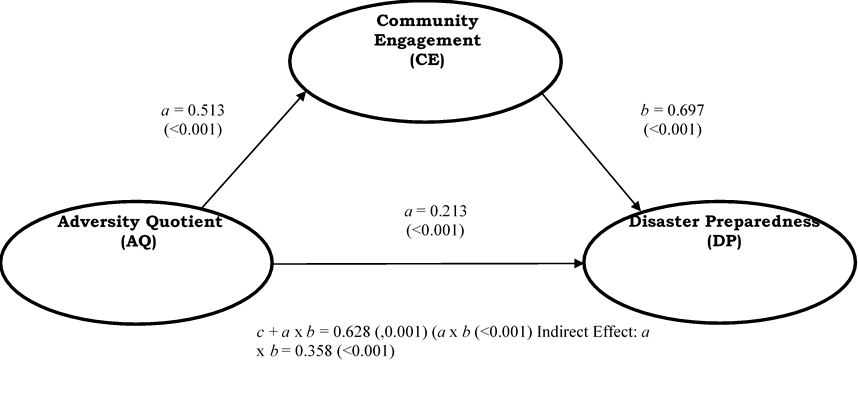
Mediation analysis confirmed that community engagement partially mediates the relationship between adversity quotient and disaster preparedness (Table 6). The indirect effect (a × b = 0.358) was significant (z = 7.18, p < .001), accounting for approximately 57% of the total effect (0.358/0.628). The direct effect remained significant (c = 0.270, z = 6.01, p < .001), indicating that adversity quotient influences disaster preparedness both directly and indirectly through community engagement.
| Effect | Estimate (B) | z-value | p-value | Decision | Interpretation |
| Indirect Effect (a × b) | 0.358 | 7.18 | <0.001 | Reject H05 | Significant |
| Total Effect (c + a × b) | 0.628 | 10.30 | <0.001 | ------- | Significant |
| AQ → DP direct (c) | 0.270 | 6.01 | <0.001 | ------- | Significant |
| AQ → CE (a) | 0.513 | 7.83 | <0.001 | ------- | Significant |
| CE → DP (b) | 0.697 | 18.05 | <0.001 | ------- | Significant |
Note: AQ – Adversity Quotient; DP – Disaster Preparedness; CE – Community Engagement
This partial mediation reveals a dual pathway: resilient teachers are more prepared both because they take direct personal action and because their resilience leads them to become more engaged in communities, which further amplifies readiness. Key informant interviews strongly supported this finding, with coordinators emphasizing that personal knowledge or resilience was insufficient without practical, collaborative action. A riverside coordinator explained that even with personal initiative, effectiveness depended on coordination with the municipal DRRM office and other stakeholders. A coastal coordinator emphasized that collaboration builds trust between school and community, transforming internal resilience into actionable, collective readiness.
Conclusion
Teacher disaster preparedness is not merely an individual psychological achievement but a collective accomplishment forged through community engagement. Teachers in Balingasag possess remarkably high personal resilience, yet this resilience achieves its full potential only when channeled through active participation in community drills, access to resources, and awareness programs. The partial mediation finding reveals a dual pathway: resilient teachers are prepared both because they take direct action and because their resilience compels them to engage with communities, which further amplifies their readiness.
The significant differences in adversity quotient by age and geographic location underscore that resilience is not static but develops through experience and is shaped by environmental demands. Older teachers and those in highrisk coastal areas have developed stronger coping mechanisms that serve them well in disaster contexts. The gap between procedural knowledge and resource management identifies a critical vulnerability requiring systemic intervention to ensure that teachers’ confidence in their skills is matched by confidence in available supplies and equipment.
Ultimately, this study delivers a compelling message to policymakers and school administrators: investing in teacher resilience alone is insufficient. What is required is a deliberate, systematic effort to formalize and strengthen schoolcommunity partnerships, ensuring that the extraordinary personal capacity of every teacher is matched by equally robust systems of resource accessibility and institutional support. The BREADY Toolkit represents a practical response to this imperative, transforming research findings into actionable strategies that can save lives when disaster strikes. By uniting individual resilience with collective engagement, schools can transform from vulnerable sites into resilient hubs of safety and stability, ensuring that education continues even in the face of disaster.
References
- Adnan, R M., & Matore, M E E M. (2022, September 29). Development of Adversity Quotient (AQ) index of pre-service teachers in Institute of Teacher Education (IPG). Frontiers Media, 10. DOI ↗ Google Scholar ↗
- Ao-Wat, J. C., & Carbonel, F. B. (2020). Disaster Preparedness of the Residents of Tabuk City: An assessment. International Journal of English Literature and Social Sciences, 5(6), 2392–2397. DOI ↗ Google Scholar ↗
- Berardi, M. K. (2024). A Community Approach to Disaster Preparedness and Response. psu.edu. DOI ↗ Google Scholar ↗
- Biñas, J. P. B., & Siason Jr, N. D. (2023). Science Behind Educational Resilience: Managing Teachers’ Adversity Quotient Towards the Academic Success in a Philippine Schools District. Open Access, 04(06). DOI ↗ Google Scholar ↗
- Bubeck, P., Osberghaus, D., & Thieken, A. H. (2023). Explaining changes in threat appraisal, coping appraisal, and Flood Risk-Reducing behavior using panel data from a Nation-Wide survey in Germany. Environment and Behavior, 55(4), 211–235. DOI ↗ Google Scholar ↗
- Cantillas, R. G. B., & Viray, M. C. (2023). Public Administration and Disaster Management: Assessment on the Prevention, Preparedness, Response, and Recovery efforts of the Cebu City Government to Typhoon Odette. International Journal of Scientific and Management Research, 06(01), 52–62. DOI ↗ Google Scholar ↗
- Desiderio, L. (2023). LGUs urged to set up emergency communication system. Philstar.com. DOI ↗ Google Scholar ↗
- Dimitrova, M., & Snair, M. (2024). Classifying disaster risk reduction strategies: conceptualizing and testing a novel integrated approach. Globalization and Health, 20(1), 7. DOI ↗ Google Scholar ↗
- Edmeade, J., & Buzinde, C. N. (2021). Educators’ personal resilience in the context of disasters triggered by natural hazards: The case of the United States Virgin Islands (USVI). International Journal of Disaster Risk Reduction, 66, 102571. DOI ↗ Google Scholar ↗
- Fu, Q., & Zhang, X. (2024). Promoting community resilience through disaster education: Review of community-based interventions with a focus on teacher resilience and well-being. PLoS ONE, 19(1), e0296393. DOI ↗ Google Scholar ↗
- Galut, M. N. A. (2025). Surviving in the trails: teachers’ lived experiences in remote areas. Frontiers in Sociology, 10, 1456269. DOI ↗ Google Scholar ↗
- Galvizo, R. (2022). The integration of disaster risk reduction education in the ASEAN region: the case of Butuan City, Philippines. SMCC Higher Education Research Journal, 9(1). DOI ↗ Google Scholar ↗
- Guo, L., Fang, M., Liu, L., Chong, H., Zeng, W., & Hu, X. (2025). The development of disaster preparedness education for public: a scoping review. BMC Public Health, 25(1). DOI ↗ Google Scholar ↗
- Kuday, A. D., Çalışkan, C., Kınık, K., Dağ, N., & Koçak, H. (2025). Development of the Perceived Challenges in Disaster Response Scale (PCDRS): Validity and Reliability study. Prehospital and Disaster Medicine, 1–8. DOI ↗ Google Scholar ↗
- Llamas, Libdan, Rolloo, & Buscano. (2025). Competence and Adversity Quotient of Teachers in Katangawan District: Basis for Professional Development Program. Psychology and Education: A Multidisciplinary Journal, 40(4), 1–1. DOI ↗ Google Scholar ↗
- Matore, M. E. E. M., Khairani, A. Z., & Razak, N. A. (2020). Development and Psychometric Properties of the Adversity Quotient Scale: An Analysis using Rasch Model and Confirmatory Factor Analysis. International Journal of Early Childhood Special Education (INT-JECSE), 29(5), 574. DOI ↗ Google Scholar ↗
- Orillo, J. C., & Prudente, M. S. (2023). Service learning on disaster readiness and risk reduction information: perspectives from students and community members. Journal of Turkish Science Education, 20(3), 433–452. DOI ↗ Google Scholar ↗
- Planos, Estillero, Depiña, Parsons, & Evarrola. (2025). Impact of Teachers&#039; Mindset, Skills, and Resilience on Teaching Performance. Journal of Interdisciplinary Perspectives, 3(4), 1–1. Google Scholar ↗
- Saxena, S., & Rathore, B. (2024). Adversity quotient as determining factor of Mental health and professional quality of life among healthcare professionals: A Systematic review. Annals of Neurosciences. DOI ↗ Google Scholar ↗
- Sonmez, E. D., & Gokmenoglu, T. (2023). Understanding the teachers’ disaster preparedness beliefs. International Journal of Disaster Risk Reduction, 85, 103511. DOI ↗ Google Scholar ↗
- Soprano, M., Roitero, K., La Barbera, D., Ceolin, D., Spina, D., Mizzaro, S., & Demartini, G. (2021). The many dimensions of truthfulness: Crowdsourcing misinformation assessments on a multidimensional scale. Information Processing & Management, 58(6), 102710. DOI ↗ Google Scholar ↗
- Vladislav Kovalevski. (2024). Capacity Building for Disaster Risk Management. Prepare Center. https://preparecenter.org/topic/capacity-building-disaster-risk-management/ Google Scholar ↗
- Vicario-Merino, A., Muñoz-Agustín, N., Ruiz-López, M., Guodemar-Pérez, J., Hervás-Pérez, J. P., & Pérez-Manchón, D. (2019). Disaster Preparedness in the Philippines: From the Will to the Way. Open Journal of Political Science, 9(3), 571–581. DOI ↗ Google Scholar ↗
- Yoro, J. M., Vicente, A. J. E., Vidad, S. R., Vicente, D. J., & Laranang, J. M. (2023). Community Residents’ Awareness and Preparedness on Disaster Management. 10(10). https://www.technoarete.org/common_abstract/pdf/IJSEM/v10/i10/Ext_20715.pdf Google Scholar ↗